
Trigonometric Identities and Applications - Solve heights and distances problems using angles of elevation and depression (30 degree, 45 degree, 60 degree)
Review the key concepts, formulae, and examples before starting your quiz.
🔑Concepts
The line of sight is the line drawn from the eye of an observer to the point in the object viewed by the observer.
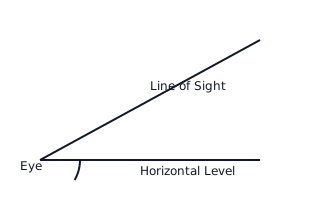
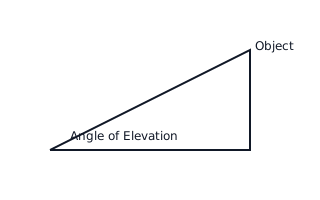
The Angle of Elevation of the point viewed is the angle formed by the line of sight with the horizontal when the point being viewed is above the horizontal level.
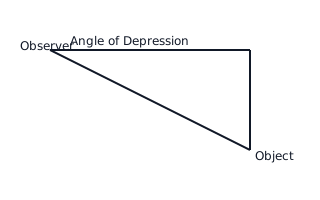
The Angle of Depression of a point on the object being viewed is the angle formed by the line of sight with the horizontal when the point is below the horizontal level.
To solve problems, identify the right-angled triangle formed and use trigonometric ratios like or based on given values.
📐Formulae
💡Examples
Problem 1:
A tower stands vertically on the ground. From a point on the ground, which is m away from the foot of the tower, the angle of elevation of the top of the tower is found to be . Find the height of the tower.
Solution:
Let be the tower of height and be the point on the ground. Given: Distance m and . In right : If we take , then m.
Explanation:
The problem provides the adjacent side (distance from the foot) and asks for the opposite side (height). Therefore, the tangent ratio is the most direct formula to use.
Problem 2:
From the top of a m high building, the angle of elevation of the top of a cable tower is and the angle of depression of its foot is . Determine the height of the tower.
Solution:
Let m be the building and be the tower. Let be the horizontal line from the top of the building to the tower. Then m. In right , the angle of depression is , so (alternate angles). Since , m. In right : Total height of tower .
Explanation:
This solution breaks the tower into two parts: the portion equal to the building height and the portion above it. We use the angle of depression to find the distance between the two structures, which then serves as the base for the second triangle to find the remaining height.
Problem 3:
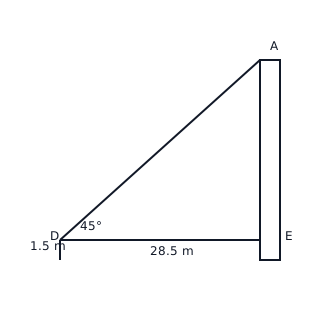
An observer m tall is m away from a chimney. The angle of elevation of the top of the chimney from her eyes is . What is the height of the chimney?
Solution:
Let be the chimney and be the observer. Here, m and the distance m. Draw . Then m and m. In right : m. Height of chimney m.
Explanation:
Since the observer has a height, we subtract it from the total height of the chimney to form a right triangle at the eye level. Using , we find the upper portion of the chimney and then add the observer's height back.
Problem 4:
The shadow of a tower standing on a level ground is found to be m longer when the Sun's altitude is than when it is . Find the height of the tower.
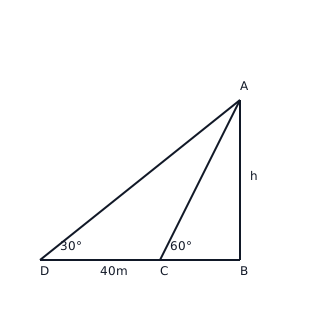
Solution:
Let be the height of the tower . Let be the shadow when altitude is . The shadow becomes when altitude is . In : ... (1) In : ... (2) Substitute (1) into (2): m.
Explanation:
We use two right triangles sharing the same height. By expressing the base of both triangles in terms of the height and using the difference between the shadow lengths (40m), we solve for the height .