
Trigonometric Identities and Applications - Establish and use simple trigonometric identities based on fundamental ratio relations
Review the key concepts, formulae, and examples before starting your quiz.
🔑Concepts
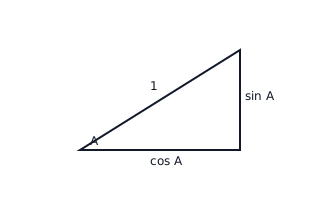
The fundamental trigonometric identities are derived from the unit circle and the Pythagorean theorem applied to a right-angled triangle where the hypotenuse is 1 unit. For any angle in a right triangle, the coordinates of a point on the unit circle are .
Reciprocal relations link the primary ratios: is the reciprocal of , is the reciprocal of , and is the reciprocal of .
Quotient relations express and in terms of sine and cosine: and .
The identity is the most fundamental identity and is used to transform expressions involving squares of sine and cosine.
The identities and relate the squared values of reciprocal functions.
📐Formulae
💡Examples
Problem 1:
Prove the identity: .
Solution:
LHS Converting to sine and cosine: Using identity : RHS.
Explanation:
The problem is solved by expressing and in terms of and , then applying the algebraic identity followed by the Pythagorean identity .
Problem 2:
Prove that .
Solution:
LHS Since : RHS.
Explanation:
We first take the LCM of the denominators. Then we expand the square and use the fundamental identity . Finally, we factorize the numerator to cancel the common term .
Problem 3:
Prove that .
Solution:
LHS = Multiply numerator and denominator by : LHS = LHS = Since , then : LHS = LHS = LHS = LHS = LHS = RHS
Explanation:
To solve expressions involving square roots, rationalize the denominator or numerator to create perfect squares, then apply the Pythagorean identity .
Problem 4:
Show that .

Solution:
LHS = LHS = LHS = Take a negative sign common from the second denominator: LHS = LHS = Use the identity : LHS = LHS = LHS = RHS
Explanation:
Convert all trigonometric ratios to sine and cosine. Simplify the complex fractions and use algebraic factorization to cancel common terms.