krit.club logo

Trigonometric Identities and Applications - Prove and apply identity sin^2A + cos^2A = 1 in simple transformations

Grade 10CBSE

Review the key concepts, formulae, and examples before starting your quiz.

🔑Concepts

•

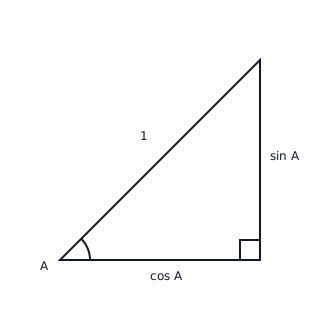
The fundamental trigonometric identity sin⁡2A+cos⁡2A=1\sin^2 A + \cos^2 A = 1 is derived from the Pythagorean theorem applied to a right-angled triangle. For a triangle with hypotenuse 11 unit, the vertical side (opposite) represents sin⁡A\sin A and the horizontal side (adjacent) represents cos⁡A\cos A.

Right triangle illustrating sine and cosine on a unit hypotenuse
•

The identity can be rearranged into two useful forms for substitution: sin⁡2A=1−cos⁡2A\sin^2 A = 1 - \cos^2 A and cos⁡2A=1−sin⁡2A\cos^2 A = 1 - \sin^2 A. These are frequently used to convert an entire expression into a single trigonometric ratio.

•

The square root forms sin⁡A=±1−cos⁡2A\sin A = \pm \sqrt{1 - \cos^2 A} and cos⁡A=±1−sin⁡2A\cos A = \pm \sqrt{1 - \sin^2 A} are used to find the value of one ratio when the other is given. For Grade 10 (acute angles), we generally take the positive square root.
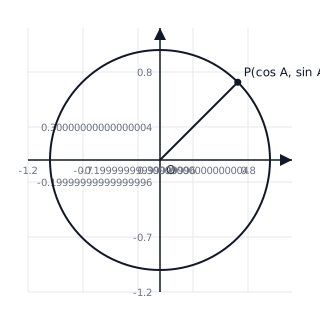
Unit circle showing coordinates as cosine and sine
•

In proving identities, look for common algebraic patterns like difference of squares: 1−sin⁡2A=(1−sin⁡A)(1+sin⁡A)1 - \sin^2 A = (1 - \sin A)(1 + \sin A).

📐Formulae

sin⁡2A+cos⁡2A=1\sin^2 A + \cos^2 A = 1

sin⁡2A=1−cos⁡2A\sin^2 A = 1 - \cos^2 A

cos⁡2A=1−sin⁡2A\cos^2 A = 1 - \sin^2 A

sin⁡A=1−cos⁡2A\sin A = \sqrt{1 - \cos^2 A}

cos⁡A=1−sin⁡2A\cos A = \sqrt{1 - \sin^2 A}

tan⁡A=sin⁡Acos⁡A\tan A = \frac{\sin A}{\cos A}

cot⁡A=cos⁡Asin⁡A\cot A = \frac{\cos A}{\sin A}

💡Examples

Problem 1:

Prove that sin⁡2θ1−cos⁡θ=1+cos⁡θ\frac{\sin^2 \theta}{1 - \cos \theta} = 1 + \cos \theta.

Solution:

LHS = sin⁡2θ1−cos⁡θ\frac{\sin^2 \theta}{1 - \cos \theta}. We know from the identity that sin⁡2θ=1−cos⁡2θ\sin^2 \theta = 1 - \cos^2 \theta. Substituting this in the numerator, we get 1−cos⁡2θ1−cos⁡θ\frac{1 - \cos^2 \theta}{1 - \cos \theta}. Applying the algebraic identity a2−b2=(a−b)(a+b)a^2 - b^2 = (a-b)(a+b), we can write 1−cos⁡2θ1 - \cos^2 \theta as (1−cos⁡θ)(1+cos⁡θ)(1 - \cos \theta)(1 + \cos \theta). So, (1−cos⁡θ)(1+cos⁡θ)1−cos⁡θ\frac{(1 - \cos \theta)(1 + \cos \theta)}{1 - \cos \theta}. Canceling the common term (1−cos⁡θ)(1 - \cos \theta) from the numerator and denominator, we get 1+cos⁡θ1 + \cos \theta, which is the RHS.

Explanation:

This solution uses the rearrangement of the primary identity sin⁡2A+cos⁡2A=1\sin^2 A + \cos^2 A = 1 to replace a squared term and then uses algebraic factorization to simplify the fraction.

Problem 2:

If sin⁡A=35\sin A = \frac{3}{5}, find the value of cos⁡A\cos A for an acute angle AA.

Solution:

We use the identity sin⁡2A+cos⁡2A=1\sin^2 A + \cos^2 A = 1. Substituting the given value: (35)2+cos⁡2A=1(\frac{3}{5})^2 + \cos^2 A = 1. This gives 925+cos⁡2A=1\frac{9}{25} + \cos^2 A = 1. Rearranging for cos⁡2A\cos^2 A, we get cos⁡2A=1−925=25−925=1625\cos^2 A = 1 - \frac{9}{25} = \frac{25 - 9}{25} = \frac{16}{25}. Taking the square root of both sides, cos⁡A=1625=45\cos A = \sqrt{\frac{16}{25}} = \frac{4}{5}.

Explanation:

This approach demonstrates how the identity can be used to find the value of one trigonometric ratio when the other is known, without needing to construct a triangle.

Problem 3:

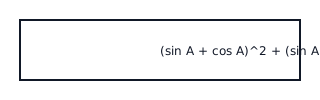
Prove that (sin⁡A+cos⁡A)2+(sin⁡A−cos⁡A)2=2(\sin A + \cos A)^2 + (\sin A - \cos A)^2 = 2.

Statement of the algebraic trigonometric identity

Solution:

L.H.S. =(sin⁡A+cos⁡A)2+(sin⁡A−cos⁡A)2= (\sin A + \cos A)^2 + (\sin A - \cos A)^2 Expanding using (a+b)2(a+b)^2 and (a−b)2(a-b)^2: =(sin⁡2A+cos⁡2A+2sin⁡Acos⁡A)+(sin⁡2A+cos⁡2A−2sin⁡Acos⁡A)= (\sin^2 A + \cos^2 A + 2\sin A \cos A) + (\sin^2 A + \cos^2 A - 2\sin A \cos A) Combining like terms: =2(sin⁡2A+cos⁡2A)= 2(\sin^2 A + \cos^2 A) Since sin⁡2A+cos⁡2A=1\sin^2 A + \cos^2 A = 1: =2(1)=2=R.H.S.= 2(1) = 2 = \text{R.H.S.}

Explanation:

This problem uses the basic identity alongside algebraic expansion to cancel out the middle terms.

Problem 4:

Simplify the expression cos⁡2A+11+cot⁡2A\cos^2 A + \frac{1}{1 + \cot^2 A}.

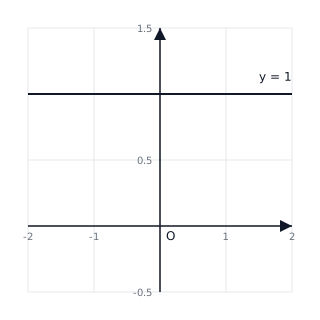
Graph showing that the sum of squares is always constant at 1

Solution:

We know that 1+cot⁡2A=csc⁡2A1 + \cot^2 A = \csc^2 A. Therefore, the expression becomes cos⁡2A+1csc⁡2A\cos^2 A + \frac{1}{\csc^2 A}. Since 1csc⁡A=sin⁡A\frac{1}{\csc A} = \sin A, then 1csc⁡2A=sin⁡2A\frac{1}{\csc^2 A} = \sin^2 A. Substituting this back: cos⁡2A+sin⁡2A\cos^2 A + \sin^2 A. Using the identity sin⁡2A+cos⁡2A=1\sin^2 A + \cos^2 A = 1, the result is 11.

Explanation:

This example demonstrates how the fundamental identity interacts with reciprocal identities to simplify complex fractions.