
Mensuration: Surface Areas and Volumes - Visualise and solve conversion problems between one solid shape and another
Review the key concepts, formulae, and examples before starting your quiz.
🔑Concepts
The fundamental principle of conversion is that the volume remains constant when a solid of one shape is melted and recast into another shape (or multiple smaller shapes), provided there is no wastage during the process.
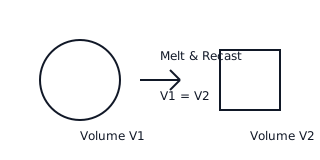
When a large solid is melted to form identical smaller solids, the equation is .
In problems involving liquid flow (like water from a pipe into a tank), the 'length' of the solid formed by the liquid is equal to .
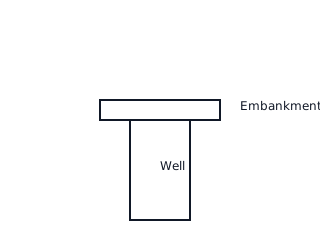
When earth is dug out from a well to form an embankment, the volume of the earth dug out equals the volume of the hollow cylindrical embankment formed around the well.
📐Formulae
Volume of a Sphere:
Volume of a Cylinder:
Volume of a Cone:
Volume of a Hemisphere:
Volume of a Cuboid:
Volume of a Cube:
Number of objects ():
💡Examples
Problem 1:
A metallic sphere of radius is melted and recast into the shape of a cylinder of radius . Find the height of the cylinder.
Solution:
- Let be the radius of the sphere and be the radius and height of the cylinder.
- Given: and .
- Since the volume remains constant during recasting: .
- .
- Dividing both sides by : .
- .
- .
- .
Explanation:
Because the metal is only changing shape and not quantity, we equate the volume of the original sphere to the volume of the new cylinder. Solving the linear equation for gives the height of the cylinder as .
Problem 2:
How many silver coins, in diameter and thickness , must be melted to form a cuboid of dimensions ?
Solution:
- For the coin (cylindrical shape): radius , thickness .
- Volume of one coin = .
- Volume of cuboid = .
- Let be the number of coins. Total volume of coins = Volume of cuboid.
- .
- .
- .
Explanation:
A coin is modeled as a cylinder with a small height. We ensure all units are in , calculate the volume of a single coin, and then divide the target volume of the cuboid by the volume of one coin to find the total count needed.
Problem 3:
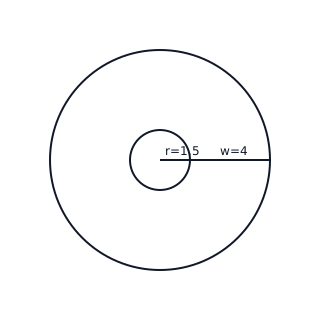
A well of diameter is dug deep. The earth taken out of it has been spread evenly all around it in the shape of a circular ring of width to form an embankment. Find the height of the embankment.
Solution:
- Volume of earth dug from well: Radius , Depth .
- Dimensions of Embankment: Inner radius , Width . Outer radius .
- Volume of Embankment: Let height be .
- Equating volumes:
Explanation:
The volume of the cylindrical well corresponds to the volume of the hollow cylinder (the embankment) formed by the displaced soil.
Problem 4:
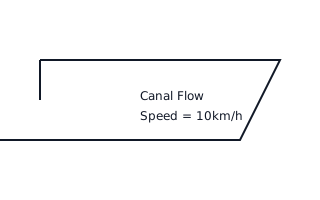
Water in a canal, wide and deep, is flowing with a speed of . How much area will it irrigate in minutes, if of standing water is needed?
Solution:
- Volume of water in 30 mins: Speed . Length of water in () .
- Area of irrigation: Let area be . Standing water height .
Explanation:
The volume of water flowing through the rectangular canal in a specific time is treated as a cuboid, which then forms another cuboid of a very large area and small height on the field.