
Mensuration: Surface Areas and Volumes - Compute volumes of composite solids formed from two standard three-dimensional shapes
Review the key concepts, formulae, and examples before starting your quiz.
🔑Concepts
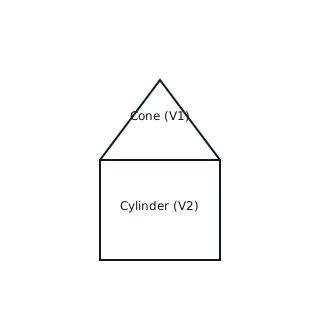
Volume of a composite solid is the sum of the volumes of the individual standard solids that form it. When two solids are joined, their total volume is given by . Unlike surface area, we do not subtract the area of the common interface.
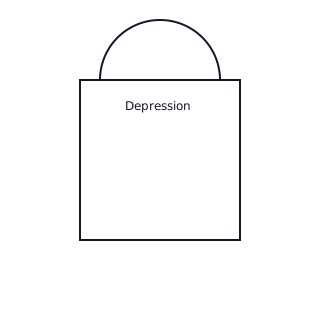
When a shape is hollowed out from another (like a hemispherical depression in a cube), the volume of the resulting solid is the difference: .
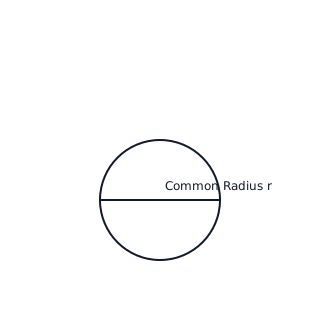
Always identify the common dimensions. For example, if a cone is mounted on a cylinder, they often share the same radius .
The total height of a composite solid is the sum of the heights of its components. For a capsule (cylinder with two hemispherical ends), .
📐Formulae
Volume of a Cuboid:
Volume of a Cube:
Volume of a Right Circular Cylinder:
Volume of a Right Circular Cone:
Volume of a Sphere:
Volume of a Hemisphere:
💡Examples
Problem 1:
A solid is in the form of a cone standing on a hemisphere with both their radii being equal to and the height of the cone is equal to its radius. Find the volume of the solid in terms of .
Solution:
Step 1: Identify the two solids. The object is a combination of a cone and a hemisphere. \nStep 2: List the given dimensions. Radius () of both cone and hemisphere = . Height () of the cone = . \nStep 3: Calculate the volume of the cone part: . \nStep 4: Calculate the volume of the hemisphere part: . \nStep 5: Add the volumes for the total volume: .
Explanation:
Since the cone and hemisphere are joined together, we simply calculate their individual volumes using the standard formulae and add them. The problem asks for the answer 'in terms of ', so we do not substitute or .
Problem 2:
A decorative block is made of two solids — a cube and a hemisphere. The base of the block is a cube with edge , and the hemisphere fixed on the top has a diameter of . Find the total volume of the block. (Use )
Solution:
Step 1: Identify the parts. We have a cube and a hemisphere sitting on top of it. \nStep 2: Note the dimensions. Edge of cube () = . Radius of hemisphere () = . \nStep 3: Calculate the volume of the cube: . \nStep 4: Calculate the volume of the hemisphere: . . \nStep 5: Total volume of the block = .
Explanation:
In this problem, the hemisphere is placed on top of the cube. The volume of the block is the sum of the space occupied by the cube and the space occupied by the hemisphere. Note that for volume, the area where they touch (the base of the hemisphere) does not need to be subtracted, unlike when calculating surface area.
Problem 3:
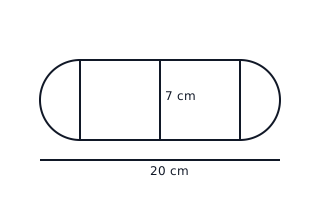
A solid toy is in the form of a cylinder with hemispherical ends. The total length of the toy is and the diameter of the cylinder is . Find the volume of the toy. (Use )
Solution:
- Radius of the cylinder and hemispheres .
- Total length of toy .
- Height of the cylindrical part .
- Volume of the toy
Explanation:
To find the volume of a capsule-shaped solid, we calculate the volume of the central cylinder and add the volumes of the two hemispheres at the ends. Note that the height of the cylinder is found by subtracting the radii of both hemispheres from the total length.
Problem 4:
A solid is composed of a cylinder of height and radius , surmounted by a cone of height . Find the volume of the solid.
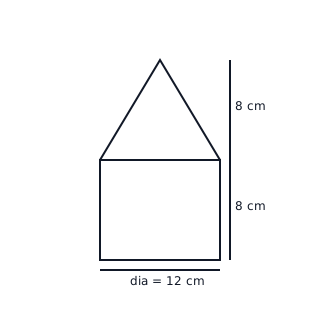
Solution:
- Radius of cylinder and cone .
- Height of cylinder .
- Height of cone .
- Total Volume Taking :
Explanation:
The volume of the composite solid is the sum of the volume of the cylinder and the volume of the cone. Since both share the same base, the radius is constant for both parts.