
Mensuration: Surface Areas and Volumes - Compute surface areas of combinations of cubes, cuboids, cylinders, cones, spheres, and hemispheres
Review the key concepts, formulae, and examples before starting your quiz.
🔑Concepts
Total Surface Area (TSA) of a combination of solids is the sum of the surface areas of the individual parts that are exposed. When two solids are joined, the surfaces that are in contact (overlap) are subtracted from the sum of the total surface areas, or we simply add the Curved Surface Areas (CSA) of the components.
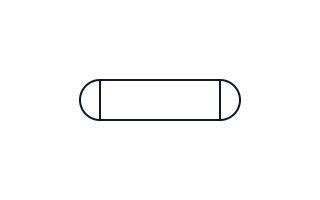
For a solid composed of a cylinder and two hemispheres at its ends, the TSA is calculated as: . Note that the circular bases of the cylinder are hidden by the hemispheres and are not included in the calculation.
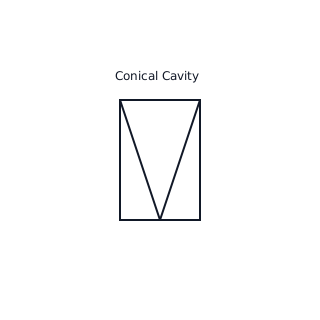
When a conical cavity is drilled out of a cylinder, the total surface area of the remaining solid increases. It includes the , the area of the remaining base (), and the inner created by the cavity.
For solids involving a cone, the slant height is often required for the Curved Surface Area (). It is calculated using the Pythagorean theorem: , where is the radius and is the vertical height.
📐Formulae
CSA of Cylinder =
CSA of Cone = , where
CSA of Hemisphere =
Surface Area of Sphere =
TSA of Cube = (where is the edge length)
TSA of Cuboid =
Area of Circle (Base) =
💡Examples
Problem 1:
A toy is in the form of a cone of radius cm mounted on a hemisphere of the same radius. The total height of the toy is cm. Find the total surface area of the toy.
Solution:
- Radius of cone and hemisphere () = cm.
- Total height of the toy = cm.
- Height of the conical part () = Total height - Radius of hemisphere = cm.
- Slant height of the cone ():
- TSA of toy = CSA of cone + CSA of hemisphere
- TSA =
- TSA =
- TSA = .
Explanation:
To solve this, we first identify that the flat circular faces of the cone and hemisphere are joined and hidden. Thus, we only add the curved surface areas. We must subtract the hemisphere's radius from the total height to find the cone's vertical height, then use Pythagoras to find the slant height.
Problem 2:
A medicine capsule is in the shape of a cylinder with two hemispheres stuck to each of its ends. The length of the entire capsule is mm and the diameter of the capsule is mm. Find its surface area.
Solution:
- Diameter = mm, so Radius () = mm.
- Total length = mm.
- Length of cylindrical part () = Total length - (Radius of left hemisphere + Radius of right hemisphere) = mm.
- Surface area of capsule = CSA of cylinder + CSA of hemisphere
- SA =
- SA =
- SA =
- SA = .
Explanation:
The capsule is a combination of one cylinder and two hemispheres. Since the hemispheres are at the ends, the total surface area is the sum of the curved surface area of the cylinder and the curved surface areas of both hemispheres. We calculate the cylinder's height by subtracting the radii of the two ends from the total length.
Problem 3:
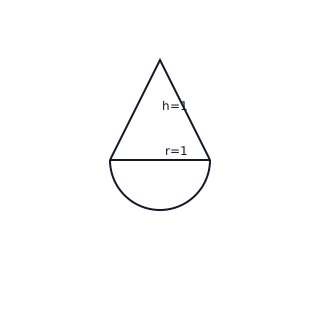
A solid is in the shape of a cone standing on a hemisphere with both their radii being equal to cm and the height of the cone is equal to its radius. Find the surface area of the solid in terms of .
Solution:
Given: Radius of hemisphere () = cm Radius of cone () = cm Height of cone () = cm
-
Calculate slant height () of the cone:
-
Surface Area of the solid =
Explanation:
The surface area consists of the curved portion of the cone and the curved portion of the hemisphere. The circular bases where they meet are internal and not counted.
Problem 4:
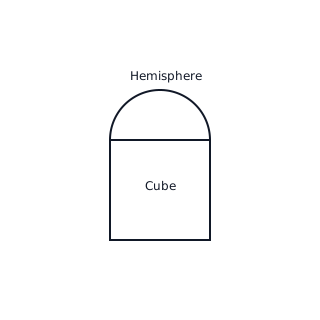
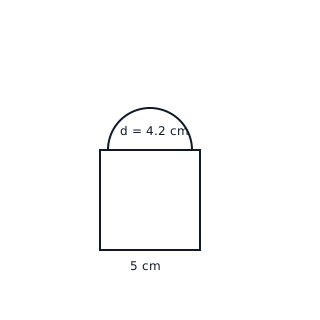
A decorative block is made of two solids — a cube and a hemisphere. The base of the block is a cube with edge cm, and the hemisphere fixed on the top has a diameter of cm. Find the total surface area of the block.
Solution:
Given: Edge of cube () = cm Diameter of hemisphere = cm Radius () = cm
-
Surface area of cube =
-
Area of the base of the hemisphere =
-
CSA of hemisphere =
-
Total Surface Area = (TSA of cube) - (Base area of hemisphere) + (CSA of hemisphere) Total Surface Area =
Explanation:
The hemisphere covers a part of the top face of the cube. We subtract the area of the circular base of the hemisphere from the cube's total surface area and then add the curved surface area of the hemisphere.