
Review the key concepts, formulae, and examples before starting your quiz.
🔑Concepts
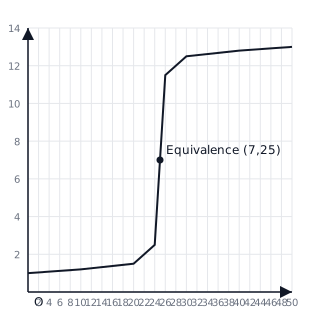
The pH curve for a strong acid-strong base titration is characterized by a very large vertical region (the pH jump) around the equivalence point. The equivalence point occurs exactly at at because the salt formed (e.g., ) does not undergo hydrolysis.
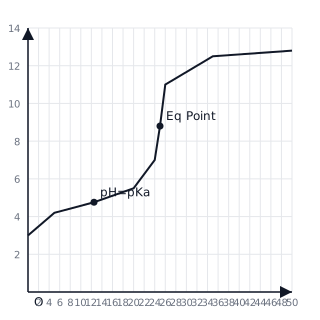
In a weak acid-strong base titration, the curve starts at a higher pH. It features a 'buffer region' where the pH changes slowly despite the addition of base. The half-equivalence point is a critical feature where and . The equivalence point occurs at due to the hydrolysis of the conjugate base.
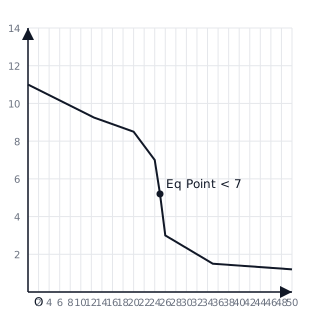
For a weak base-strong acid titration, the curve starts at a high pH (around ). The pH drops slowly in the buffer region. The equivalence point occurs at because the conjugate acid of the weak base (e.g., ) hydrolyzes to produce ions.
The choice of indicator is determined by the pH range of the vertical section of the titration curve. An indicator is suitable if its range falls within the steep vertical portion of the curve. For example, Phenolphthalein (range ) is ideal for weak acid-strong base titrations.
📐Formulae
(Henderson-Hasselbalch Equation)
💡Examples
Problem 1:
Calculate the at the half-equivalence point when of is titrated with . The acid dissociation constant for ethanoic acid is at .
Solution:
Explanation:
At the half-equivalence point, exactly half of the has reacted to form . Thus, . Substituting these equal values into the Henderson-Hasselbalch equation makes the log term , leaving .
Problem 2:
Explain why the at the equivalence point for the titration of with is less than .
Solution:
The salt formed is . The ion is the conjugate acid of a weak base and undergoes hydrolysis: .
Explanation:
Since the hydrolysis of the ammonium ion produces hydronium ions (), the concentration of increases, resulting in an acidic at the stoichiometric equivalence point.
Problem 3:
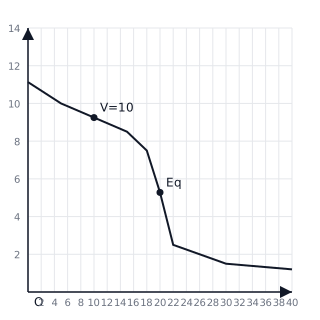
Identify the type of titration represented by the provided pH curve where the initial is , the half-equivalence point occurs at after adding of titrant, and the equivalence point is reached at with of titrant.
Solution:
- Initial indicates a weak base.
- The titrant added is an acid since the decreases.
- The equivalence point (less than ) confirms it is a weak base-strong acid titration.
- At (half-equivalence), . Since , . Thus, .
Explanation:
The shape shows a buffer region starting from a basic pH and a steep drop through the acidic range, characteristic of titrated with .
Problem 4:
A sample of methanoic acid (, ) is titrated with . Sketch the curve and calculate the after and of have been added.
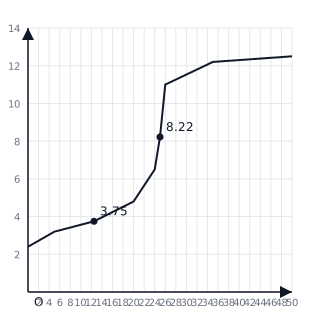
Solution:
- At : This is the half-equivalence point (). At this point, .
- At : This is the equivalence point. All is converted to . The concentration of is (due to doubling the volume).
- . Since , .
- .
Explanation:
The curve starts at a low (but not very low) pH, rises through a buffer region to the half-equivalence point, and has an equivalence point in the basic region.