
Review the key concepts, formulae, and examples before starting your quiz.
🔑Concepts
The Distance Formula calculates the length of the line segment connecting two points and in a Cartesian plane, derived using the Pythagorean Theorem.
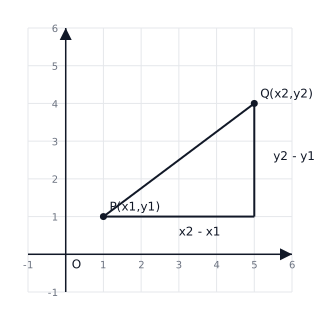
Distance from the Origin: For any point , its distance from the origin is simplified as the square root of the sum of the squares of its coordinates.
Collinearity: Three points , , and are collinear if the sum of the distances between two pairs of points equals the distance between the third pair, such as .
Properties of Geometrical Figures: The distance formula is used to identify types of triangles (Equilateral, Isosceles, Right-angled) and quadrilaterals (Square, Rectangle, Rhombus) based on side lengths and diagonal equality.
📐Formulae
💡Examples
Problem 1:
Find the distance between the points and .
Solution:
- Identify the coordinates: and .\
- Apply the distance formula: .\
- Substitute the values: .\
- Simplify inside the brackets: .\
- Calculate the squares: .\
- Find the square root: units.
Explanation:
This problem uses the standard distance formula to find the length of the segment connecting two points across different quadrants.
Problem 2:
Find the value of if the distance between the points and is units.
Solution:
- Use the distance formula: .\
- Given , so .\
- Square both sides to remove the square root: .\
- Subtract from both sides: .\
- Take the square root of both sides: .\
- Case 1: .\
- Case 2: .\
- Therefore, or .
Explanation:
This example demonstrates how to solve for an unknown coordinate when the distance is already known by forming and solving a quadratic equation.
Problem 3:
Show that the points , , and form an isosceles triangle.
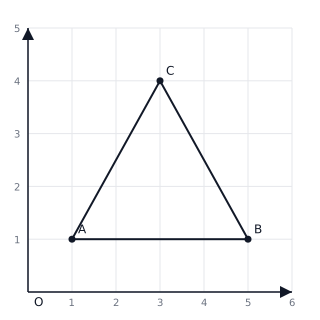
Solution:
- Find : units.
- Find : units.
- Find : units. Since , triangle is an isosceles triangle.
Explanation:
To prove a triangle is isosceles, calculate all three side lengths using the distance formula and check if at least two sides are equal.
Problem 4:
Find a point on the x-axis which is equidistant from and .
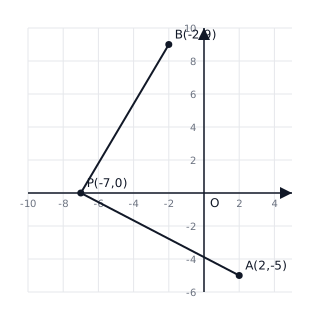
Solution:
Let the required point on the x-axis be . Given , then . The point is .
Explanation:
A point on the x-axis always has a y-coordinate of . We use the distance formula to set the distance from to equal to the distance from to .