
Review the key concepts, formulae, and examples before starting your quiz.
🔑Concepts
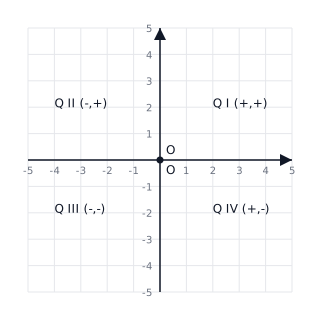
The Cartesian coordinate system is formed by two mutually perpendicular lines called axes: the horizontal -axis and the vertical -axis. Their point of intersection is called the Origin . The axes divide the plane into four regions called quadrants: Quadrant I (top right), Quadrant II (top left), Quadrant III (bottom left), and Quadrant IV (bottom right).
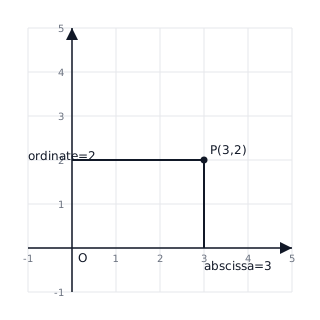
Any point in the plane is represented by an ordered pair , where is the abscissa (perpendicular distance from the -axis) and is the ordinate (perpendicular distance from the -axis). To plot , move 3 units right and 2 units up from the origin.
Points on the -axis have an ordinate of 0, taking the form . Points on the -axis have an abscissa of 0, taking the form .
Reflection of a point: The reflection of in the -axis is . The reflection in the -axis is . The reflection in the origin is .
📐Formulae
Coordinates of Origin:
Equation of -axis:
Equation of -axis:
General form of a point on -axis:
General form of a point on -axis:
Distance between two points and :
💡Examples
Problem 1:
Identify the quadrant or axis for the following points without plotting them: , , , and .
Solution:
- For point : The -coordinate is positive and the -coordinate is negative (). This corresponds to Quadrant IV.
- For point : Both and coordinates are negative (). This corresponds to Quadrant III.
- For point : The -coordinate is . Any point with lies on the -axis. Since is positive, it is on the positive -axis.
- For point : The -coordinate is negative and the -coordinate is positive (). This corresponds to Quadrant II.
Explanation:
Quadrants are determined by the signs of the coordinates: I , II , III , and IV . Points with a zero coordinate lie on the axes.
Problem 2:
Find the distance between the points and .
Solution:
Step 1: Identify coordinates: and . Step 2: Use the distance formula: . Step 3: Substitute values: . Step 4: Simplify inside the square root: . Step 5: Calculate squares: . Step 6: Final result: units.
Explanation:
The distance formula is derived from the Pythagoras theorem applied to the horizontal and vertical distances between two points.
Problem 3:
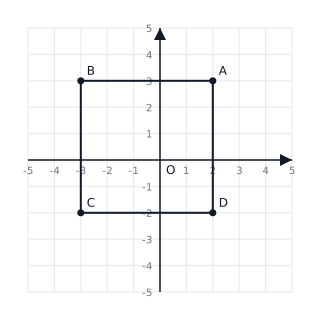
Plot the points , , , and on a graph and identify the geometrical figure formed by joining them in order.
Solution:
- Plot in Q I, in Q II, in Q III, and in Q IV.
- Join , , , and .
- Length units.
- Length units.
- Since all sides are equal and adjacent sides are perpendicular, is a square.
Explanation:
By calculating the distances between adjacent vertices using the horizontal and vertical differences, we find that all sides are equal to 5 units. Since the axes are perpendicular, the shape formed by these horizontal and vertical lines is a square.
Problem 4:
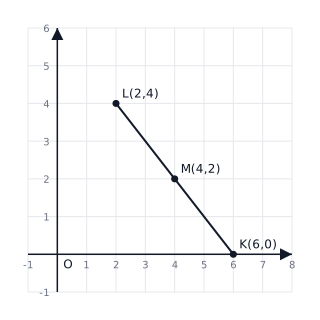
Find the coordinates of the midpoint of the line segment joining points and .
Solution:
The midpoint of a segment with endpoints and is given by: Therefore, .
Explanation:
The midpoint is the average of the -coordinates and the -coordinates of the two endpoints.