
Linear Equations in Two Variables - Solve a pair of linear equations graphically and interpret intersection meaning
Review the key concepts, formulae, and examples before starting your quiz.
🔑Concepts
A linear equation in two variables, such as , represents a straight line on a Cartesian plane. Every point that satisfies the equation lies on this line.
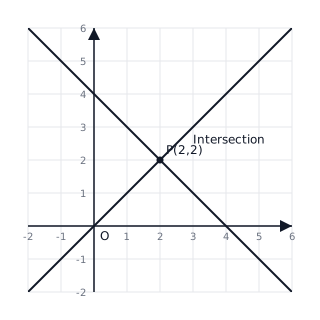
The point where two lines intersect is the unique solution to the pair of linear equations. If the lines are and , the coordinates of the intersection point satisfy both equations simultaneously.
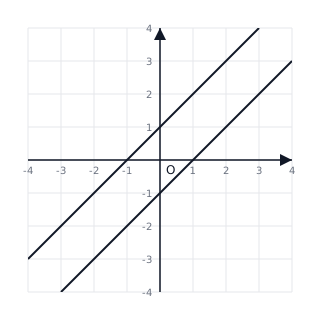
If two lines are parallel, they never intersect. This means the pair of linear equations has no solution. For example, the lines and have the same slope and different intercepts.
If two lines coincide (overlap completely), every point on the line is a solution. This occurs when one equation is a non-zero multiple of the other, resulting in infinitely many solutions.
📐Formulae
General form of a linear equation in two variables:
Equation of the -axis:
Equation of the -axis:
Equation of a line parallel to the -axis:
Equation of a line parallel to the -axis:
Equation of a line passing through the origin:
💡Examples
Problem 1:
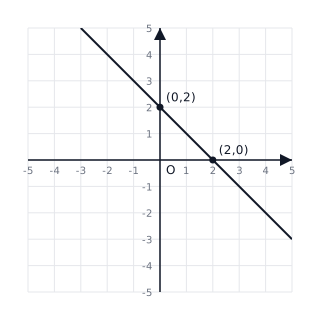
Draw the graph of the linear equation .
Solution:
- Find at least two solutions for the equation.
- Let : . Point is .
- Let : . Point is .
- Let : . Point is .
- Plot the points , , and on a Cartesian plane.
- Use a ruler to draw a straight line passing through these points and extend it with arrows at both ends.
Explanation:
This approach uses the intercept method (setting and ) to find where the line crosses the axes, which is the most efficient way to graph a linear equation.
Problem 2:
Check whether the point lies on the graph of the equation .
Solution:
- Substitute and into the Left Hand Side (LHS) of the equation .
- .
- .
- Since , the point satisfies the equation.
Explanation:
If a point satisfies the algebraic equation of the line, it must geometrically lie on the line when represented on a graph. Since the calculation holds true, the point is a part of the line's graph.
Problem 3:
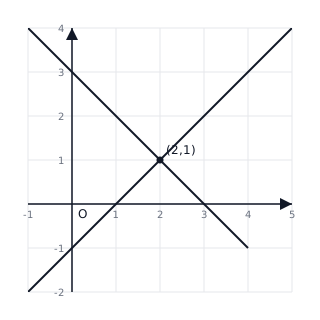
Solve the pair of equations and graphically and identify the point of intersection.
Solution:
- For , points are and .
- For , points are and .
- Plotting these lines, they intersect at .
- Verification: and . The solution is .
Explanation:
To solve graphically, we find at least two points for each line, draw the lines on the coordinate plane, and find the coordinates where they cross.
Problem 4:
Determine the area of the triangle formed by the lines , , and the -axis.
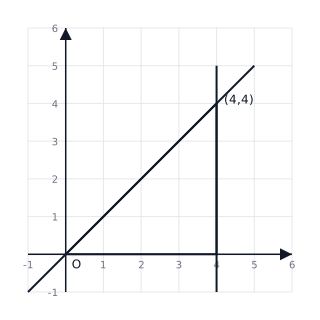
Solution:
- The line passes through and .
- The line is a vertical line passing through .
- The -axis is the line .
- The vertices of the triangle are , , and .
- Base units (from to on the -axis).
- Height units (from to at ).
- Area = sq units.
Explanation:
Intersection points of the three lines define the vertices of the triangle. The area is then calculated using the geometric formula for a triangle.