
Review the key concepts, formulae, and examples before starting your quiz.
🔑Concepts
The Sine ratio () connects the angle to the ratio of the side opposite to it and the hypotenuse: .
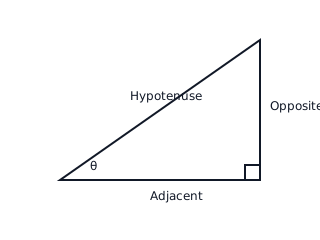
The Cosine ratio () defines the relationship between the angle and the ratio of the adjacent side to the hypotenuse: .
The Tangent ratio () relates the opposite side to the adjacent side: . This is useful when the hypotenuse is unknown.
SOH CAH TOA is a common mnemonic to remember the ratios: Sine=Opp/Hyp, Cosine=Adj/Hyp, and Tangent=Opp/Adj.
To find an unknown angle, use the inverse trigonometric functions: , , or .
📐Formulae
💡Examples
Problem 1:
In a right-angled triangle, the hypotenuse is 10 cm and the angle is 30°. Calculate the length of the opposite side.
Solution:
Opposite = cm
Explanation:
We are given the Hypotenuse (10) and an Angle (30°), and we need to find the Opposite side. According to SOH, we use the Sine ratio. Rearranging gives .
Problem 2:
A right-angled triangle has an adjacent side of 7 cm and an opposite side of 5 cm. Find the value of the angle .
Solution:
Explanation:
We are given the Opposite (5) and Adjacent (7) sides. According to TOA, we use the Tangent ratio. To find the angle, we use the inverse tangent function: .
Problem 3:
Find the length of the adjacent side if the hypotenuse is 15 cm and the angle is 60°.
Solution:
Adjacent = cm
Explanation:
We have the Hypotenuse and need the Adjacent side. According to CAH, we use the Cosine ratio. Rearranging gives .
Problem 4:
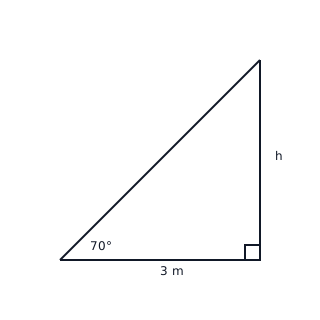
A ladder leans against a vertical wall. The foot of the ladder is from the wall and the ladder makes an angle of with the ground. Calculate the height the ladder reaches up the wall.
Solution:
- Identify the sides relative to the angle: Adjacent side , Opposite side .
- Choose the Tangent ratio: .
- Substitute values: .
- Rearrange for : .
- Calculate: .
Explanation:
Since we have the adjacent side and need the opposite side, Tangent is the correct ratio to use.
Problem 5:
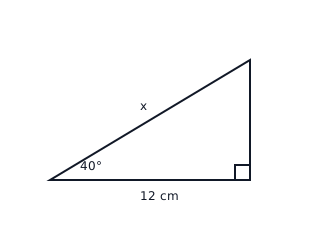
Calculate the length of the hypotenuse in a right-angled triangle where the side adjacent to a angle is .
Solution:
- Identify the sides: Adjacent side , Hypotenuse .
- Choose the Cosine ratio: .
- Substitute values: .
- Rearrange for : .
- Calculate: .
Explanation:
We use Cosine because the information given includes the adjacent side and requires the hypotenuse.