
Review the key concepts, formulae, and examples before starting your quiz.
🔑Concepts
In a right-angled triangle, the three sides are named relative to a specific angle : the Hypotenuse (opposite the angle), the Opposite (across from ), and the Adjacent (next to ).
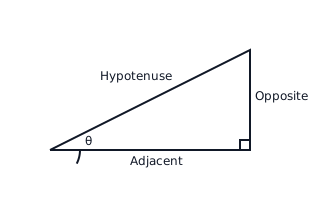
The SOH CAH TOA mnemonic helps remember the ratios: , , and .
To find an unknown side, identify the two sides involved (one known, one unknown) and the given angle, then choose the ratio that links them.
To find an unknown angle, use the inverse trigonometric functions: , , or on the ratio of the two known sides.
📐Formulae
(Pythagoras' Theorem)
💡Examples
Problem 1:
In a right-angled triangle, the hypotenuse is 12 cm and one angle is 35°. Calculate the length of the side opposite to the 35° angle. Give your answer to 2 decimal places.
Solution:
6.88 cm
Explanation:
- Identify the given information: Angle , Hypotenuse = 12 cm. We need the Opposite side. 2. Choose the ratio: SOH uses Opposite and Hypotenuse. 3. Set up the equation: . 4. Solve for : 5. Round to 2 decimal places.
Problem 2:
A right-angled triangle has an adjacent side of 7 cm and an opposite side of 5 cm relative to an angle . Find the value of to 1 decimal place.
Solution:
35.5°
Explanation:
- Identify the given information: Opposite = 5 cm, Adjacent = 7 cm. 2. Choose the ratio: TOA uses Opposite and Adjacent. 3. Set up the equation: . 4. Use the inverse tangent function: . 5. Calculate: 6. Round to 1 decimal place.
Problem 3:
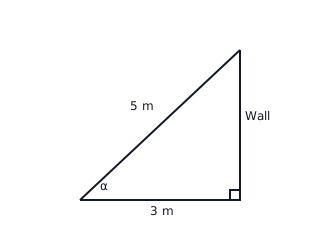
A ladder 5 m long leans against a vertical wall. The base of the ladder is 3 m away from the wall. Calculate the angle that the ladder makes with the ground. Give your answer to 1 decimal place.
Solution:
Explanation:
Identify the sides: the ladder is the hypotenuse ( m) and the distance from the wall is the adjacent side ( m) to the angle at the ground. Using the cosine ratio allows us to solve for the angle.
Problem 4:
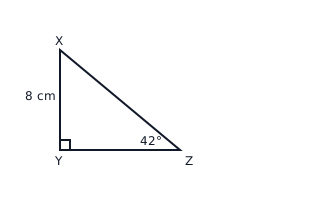
In triangle , angle , angle and the side cm. Calculate the length of the adjacent side . Give your answer to 2 decimal places.
Solution:
Explanation:
Relative to the angle at , is the opposite side and is the adjacent side. We use the tangent ratio () and rearrange the formula to solve for the denominator.