
Review the key concepts, formulae, and examples before starting your quiz.
🔑Concepts
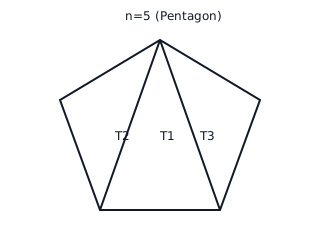
The Angle Sum Property of a polygon states that the sum of the interior angles of a convex polygon with sides is . This is derived by dividing the polygon into triangles from a single vertex.
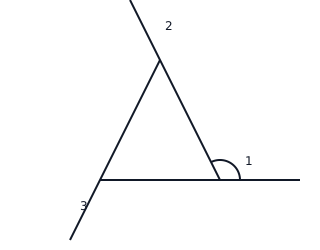
Regardless of the number of sides, the sum of the measures of the exterior angles of any convex polygon (taken one at each vertex) is always .
In a regular polygon, all interior angles are equal and all exterior angles are equal. This symmetry allows us to find the measure of a single angle by dividing the total sum by the number of sides .
At each vertex of a polygon, the interior angle and its corresponding exterior angle are supplementary, meaning their sum is always because they form a linear pair.
📐Formulae
Sum of interior angles of a polygon =
Sum of exterior angles of any polygon =
Each interior angle of a regular polygon =
Each exterior angle of a regular polygon =
Number of sides () of a regular polygon =
Interior angle + Exterior angle =
💡Examples
Problem 1:
Find the sum of the interior angles of a polygon with sides (a dodecagon).
Solution:
Step 1: Identify the number of sides, . \nStep 2: Use the formula for the sum of interior angles: \nStep 3: Substitute into the formula: \nStep 4: Calculate the values:
Explanation:
The problem asks for the total sum of all angles inside the polygon. By applying the rule, we determine how many triangles the 12-sided figure can be divided into, which is 10.
Problem 2:
Each interior angle of a regular polygon is . Find the number of sides of the polygon.
Solution:
Step 1: Find the measure of each exterior angle using the supplementary relationship: \nStep 2: Use the formula for the number of sides based on the exterior angle: \nStep 3: Substitute the exterior angle value: \nStep 4: Solve for :
Explanation:
To find the number of sides, it is often easier to find the exterior angle first. Since the interior and exterior angles sum to , we find the exterior angle is . Dividing the total exterior sum () by this value gives the number of sides.
Problem 3:
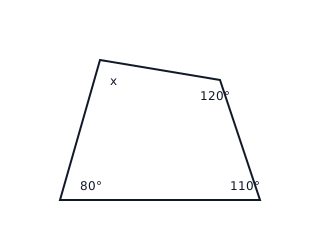
Find the value of in the given quadrilateral where three interior angles are , , and .
Solution:
- For a quadrilateral, .
- Sum of interior angles = .
- Sum of given angles = .
- .
Final Answer:
Explanation:
Since the sum of all interior angles of any quadrilateral must be , we subtract the sum of the known angles from to find the unknown angle.
Problem 4:
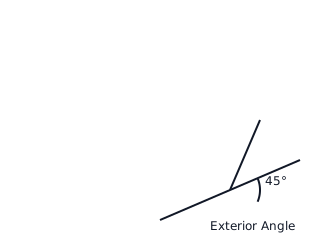
Calculate the number of sides of a regular polygon if each of its exterior angles measures .
Solution:
- We know that for a regular polygon, the number of sides .
- Given each exterior angle = .
- .
- .
Final Answer: The polygon has sides (it is a regular octagon).
Explanation:
Because the sum of exterior angles of any polygon is always , and in a regular polygon all exterior angles are equal, dividing the total sum by the measure of one angle gives the total number of vertices (sides).