
Review the key concepts, formulae, and examples before starting your quiz.
🔑Concepts
A polygon is a simple closed curve made up of only line segments. Polygons are classified by the number of sides (or vertices) they have. For example, a polygon with sides is a triangle, sides is a quadrilateral, sides is a pentagon, and so on.
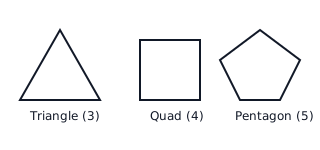
A polygon is convex if no part of its diagonals lies in its exterior. In a concave polygon, at least one diagonal (or part of it) lies in the exterior of the polygon, and at least one interior angle is greater than .

A regular polygon is both equiangular (all angles are equal) and equilateral (all sides are equal). An irregular polygon does not have all sides and angles equal.
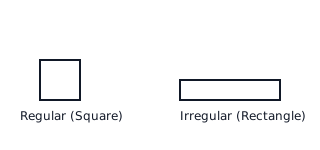
The diagonals of a polygon are line segments connecting two non-consecutive vertices. The number of diagonals increases with the number of sides.

📐Formulae
Sum of interior angles of a polygon =
Each interior angle of a regular polygon =
Sum of exterior angles of any convex polygon =
Each exterior angle of a regular polygon =
Number of diagonals in a polygon of sides =
Measure of an interior angle + Measure of its adjacent exterior angle =
💡Examples
Problem 1:
Find the sum of the interior angles of a polygon with sides.
Solution:
Step 1: Identify the number of sides, . Step 2: Use the formula for the sum of interior angles: . Step 3: Substitute into the formula: . Step 4: Solve the expression: .
Explanation:
To find the total sum of all angles inside any polygon, we subtract from the total number of sides and multiply the result by degrees.
Problem 2:
Each interior angle of a regular polygon is . Find the number of sides of the polygon.
Solution:
Step 1: Use the linear pair relationship to find the exterior angle. Exterior angle = . Step 2: Calculate: Exterior angle = . Step 3: Use the formula for the number of sides based on exterior angles: . Step 4: Substitute the value: . Step 5: Solve: .
Explanation:
In a regular polygon, all interior angles are equal, which means all exterior angles are also equal. Since the sum of exterior angles is always , dividing by the measure of one exterior angle gives the number of sides.
Problem 3:
Calculate the measure of each exterior angle of a regular hexagon.

Solution:
Explanation:
Since a regular hexagon has 6 equal sides and 6 equal exterior angles, we divide the total sum of exterior angles () by 6.
Problem 4:
Find the value of in the given quadrilateral where the interior angles are , , , and .
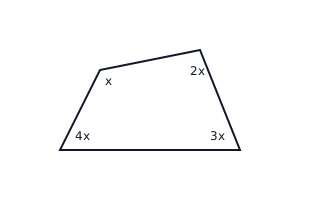
Solution:
Explanation:
The sum of interior angles of any quadrilateral is always . We set up an equation with the given ratios and solve for .