
Review the key concepts, formulae, and examples before starting your quiz.
🔑Concepts
A function is a rule that assigns each input value to exactly one output value . In a coordinate plane, the graph of a linear function is a straight line, while non-linear functions like quadratics form curves like parabolas.
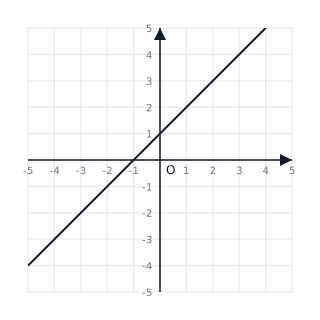
The gradient () represents the steepness of a line. A positive gradient slopes upwards from left to right, while a negative gradient slopes downwards. The -intercept () is the point where the line crosses the vertical axis.
Parallel lines have the same gradient. If two lines are parallel, their equations will have the same value in the form .
Vertical lines are written as and horizontal lines as , where is a constant. A vertical line has an undefined gradient, while a horizontal line has a gradient of .
📐Formulae
(Equation of a straight line)
(Gradient formula)
(Point-gradient form)
(Midpoint of a line segment)
💡Examples
Problem 1:
Complete the table of values for the function for values .
Solution:
For ; For ; For ; For . The coordinates are .
Explanation:
Substitute each given value into the equation to find the corresponding value, then pair them as coordinates.
Problem 2:
Find the gradient of the line passing through the points and .
Solution:
.
Explanation:
Apply the gradient formula by identifying and .
Problem 3:
Identify the gradient and y-intercept of the line with the equation .
Solution:
Divide by 2 to get . Gradient () = 3, Y-intercept () = 2.
Explanation:
To find and , the equation must first be rearranged into the standard form .
Problem 4:
What is the equation of the horizontal line that passes through the point ?
Solution:
Explanation:
A horizontal line has the same y-coordinate for every point on the line. Since it passes through , the y-value is always .
Problem 5:
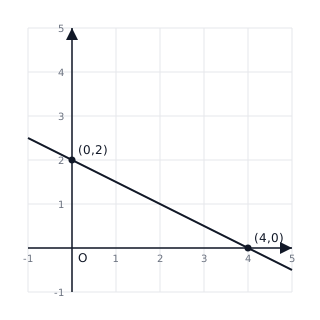
Determine the equation of the line shown in the diagram that passes through and .
Solution:
The y-intercept is (where ). Equation:
Explanation:
First, calculate the gradient using the two points provided. Since the line crosses the y-axis at 2, . Substitute and into .
Problem 6:
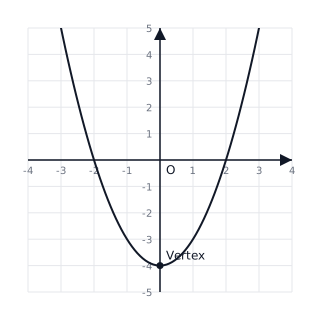
Identify the coordinates of the vertex (turning point) for the quadratic function as shown in the graph.
Solution:
The vertex is at .
Explanation:
The vertex of a parabola is the highest or lowest point. For , the lowest point occurs when , giving .