krit.club logo

Geometric Twins - Congruence of Triangles

Grade 7CBSE

Review the key concepts, formulae, and examples before starting your quiz.

🔑Concepts

•

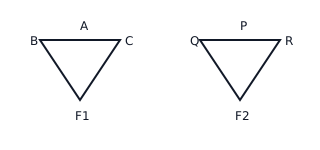
Congruence of Plane Figures: Two plane figures are congruent if they are identical in shape and size. If one figure is superimposed on another and they cover each other exactly, they are congruent. The symbol used is ≅\cong.

Two identical triangles F1 and F2 representing congruent plane figures.
•

SAS (Side-Angle-Side) Criterion: Two triangles are congruent if two sides and the included angle of one triangle are equal to the corresponding two sides and the included angle of the other triangle.
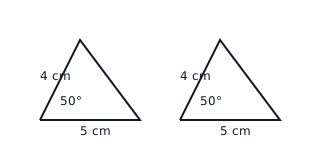
Two triangles showing equal side-angle-side measurements.
•

ASA (Angle-Side-Angle) Criterion: Two triangles are congruent if two angles and the included side of one triangle are equal to the corresponding two angles and the included side of the other triangle.
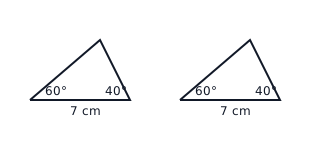
Two triangles illustrating the ASA congruence criterion with two angles and the base side.
•

RHS (Right-Angle Hypotenuse Side) Criterion: If the hypotenuse and one side of a right-angled triangle are equal to the hypotenuse and one side of another right-angled triangle, then the triangles are congruent.
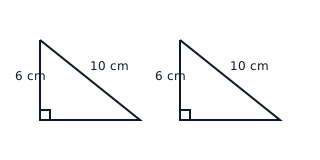
Two right-angled triangles showing equal hypotenuse and one equal side.

📐Formulae

If △ABC≅△PQR, then:\text{If } \triangle ABC \cong \triangle PQR, \text{ then:}

AB=PQ,BC=QR,AC=PRAB = PQ, BC = QR, AC = PR

∠A=∠P,∠B=∠Q,∠C=∠R\angle A = \angle P, \angle B = \angle Q, \angle C = \angle R

SSS Criterion: S1=S1,S2=S2,S3=S3  ⟹  ≅\text{SSS Criterion: } S_1=S_1, S_2=S_2, S_3=S_3 \implies \cong

SAS Criterion: S1=S1,∠included=∠included,S2=S2  ⟹  ≅\text{SAS Criterion: } S_1=S_1, \angle_{included}=\angle_{included}, S_2=S_2 \implies \cong

ASA Criterion: ∠1=∠1,Sincluded=Sincluded,∠2=∠2  ⟹  ≅\text{ASA Criterion: } \angle_1=\angle_1, S_{included}=S_{included}, \angle_2=\angle_2 \implies \cong

RHS Criterion: ∠90∘=∠90∘,hypotenuse1=hypotenuse2,side1=side2  ⟹  ≅\text{RHS Criterion: } \angle 90^\circ = \angle 90^\circ, \text{hypotenuse}_1 = \text{hypotenuse}_2, \text{side}_1 = \text{side}_2 \implies \cong

💡Examples

Problem 1:

In △ABC\triangle ABC and △PQR\triangle PQR, AB=3.5 cmAB = 3.5\text{ cm}, BC=7.1 cmBC = 7.1\text{ cm}, AC=5 cmAC = 5\text{ cm}, PQ=7.1 cmPQ = 7.1\text{ cm}, QR=5 cmQR = 5\text{ cm}, and PR=3.5 cmPR = 3.5\text{ cm}. Examine whether the two triangles are congruent. If yes, write the congruence relation in symbolic form.

Solution:

Given: AB=3.5 cm=PRAB = 3.5\text{ cm} = PR, BC=7.1 cm=PQBC = 7.1\text{ cm} = PQ, AC=5 cm=QRAC = 5\text{ cm} = QR. Since all three sides of △ABC\triangle ABC are equal to the three sides of △PQR\triangle PQR, the triangles are congruent by SSS criterion.

Explanation:

By checking the correspondence: A↔RA \leftrightarrow R, B↔PB \leftrightarrow P, and C↔QC \leftrightarrow Q. Therefore, △ABC≅△RPQ\triangle ABC \cong \triangle RPQ.

Problem 2:

In △LMN\triangle LMN, ∠M=90∘\angle M = 90^\circ, LN=5 cmLN = 5\text{ cm}, and MN=3 cmMN = 3\text{ cm}. In △XYZ\triangle XYZ, ∠Y=90∘\angle Y = 90^\circ, XZ=5 cmXZ = 5\text{ cm}, and YZ=3 cmYZ = 3\text{ cm}. Are the triangles congruent?

Solution:

In △LMN\triangle LMN and △XYZ\triangle XYZ: 1. ∠M=∠Y=90∘\angle M = \angle Y = 90^\circ (Right angle), 2. LN=XZ=5 cmLN = XZ = 5\text{ cm} (Hypotenuse), 3. MN=YZ=3 cmMN = YZ = 3\text{ cm} (Side). Thus, △LMN≅△XYZ\triangle LMN \cong \triangle XYZ by RHS criterion.

Explanation:

Two right-angled triangles are congruent if their hypotenuses and one pair of corresponding sides are equal.

Problem 3:

If △DEF≅△BCA\triangle DEF \cong \triangle BCA, write the part(s) of △BCA\triangle BCA that correspond to: (i) ∠E\angle E, (ii) EFEF, (iii) ∠F\angle F, (iv) DFDF.

Solution:

(i) ∠E↔∠C\angle E \leftrightarrow \angle C, (ii) EF↔CAEF \leftrightarrow CA, (iii) ∠F↔∠A\angle F \leftrightarrow \angle A, (iv) DF↔BADF \leftrightarrow BA.

Explanation:

The correspondence is determined by the order of letters in the congruence statement: D→BD \to B, E→CE \to C, and F→AF \to A.

Problem 4:

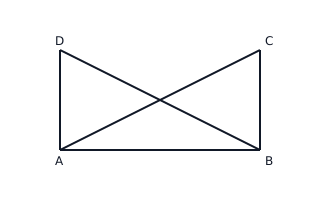
In the given figure, DA⊥ABDA \perp AB, CB⊥ABCB \perp AB and AC=BDAC = BD. State the three pairs of equal parts in △ABC\triangle ABC and △BAD\triangle BAD. Is △ABC≅△BAD\triangle ABC \cong \triangle BAD?

A rectangle-like base with diagonals AC and BD and perpendiculars DA and CB on line AB.

Solution:

In △ABC\triangle ABC and △BAD\triangle BAD:

  1. ∠ABC=∠BAD=90∘\angle ABC = \angle BAD = 90^\circ (Given)
  2. AC=BDAC = BD (Hypotenuse, given)
  3. AB=BAAB = BA (Common side)

Therefore, by RHS congruence criterion, △ABC≅△BAD\triangle ABC \cong \triangle BAD.

Explanation:

Since both triangles share a common base, have a right angle, and equal hypotenuses, they satisfy the Right-Angle Hypotenuse Side (RHS) condition.

Problem 5:

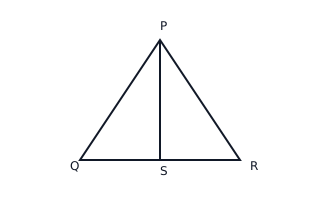
In △PQR\triangle PQR, PQ=PRPQ = PR and PSPS is the bisector of ∠QPR\angle QPR. Prove that △PQS≅△PRS\triangle PQS \cong \triangle PRS.

An isosceles triangle PQR with an altitude PS from P to the base QR.

Solution:

In △PQS\triangle PQS and △PRS\triangle PRS:

  1. PQ=PRPQ = PR (Given)
  2. ∠QPS=∠RPS\angle QPS = \angle RPS (PSPS bisects ∠P\angle P)
  3. PS=PSPS = PS (Common side)

By SAS criterion, △PQS≅△PRS\triangle PQS \cong \triangle PRS.

Explanation:

The SAS criterion is applied here because we have two sides and the angle included between them equal in both triangles.