
Review the key concepts, formulae, and examples before starting your quiz.
🔑Concepts
An Isosceles triangle is a triangle with at least two equal sides. The angles opposite to these equal sides are also equal. These are known as the base angles, while the third angle is the vertex angle.
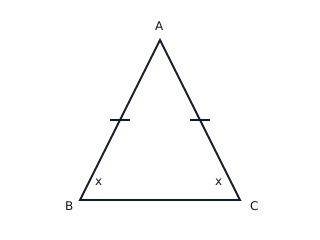
An Equilateral triangle has all three sides equal. Consequently, all three interior angles are equal. Since the sum of angles in a triangle is , each angle must be .
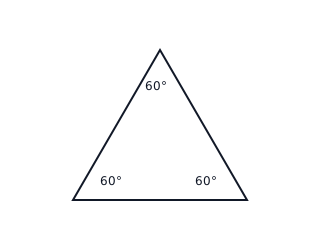
In an isosceles triangle, if the vertex angle is known, the base angles can be found using the formula: .
The Angle Sum Property states that the sum of all internal angles of any triangle (including isosceles and equilateral) is always .
📐Formulae
💡Examples
Problem 1:
In an isosceles triangle, the vertex angle is . Find the measure of the base angles.
Solution:
Let the triangle be with vertex angle . Let the base angles be and . Since it is an isosceles triangle, . Using the angle sum property: . So, the base angles are each.
Explanation:
We use the property that base angles of an isosceles triangle are equal and then apply the Angle Sum Property () to solve for the unknown.
Problem 2:
One of the base angles of an isosceles triangle is . Determine the measure of the vertex angle.
Solution:
Let the base angles be and . Given . Since base angles are equal, . Let the vertex angle be . The vertex angle is .
Explanation:
Since two angles are each, their sum is . Subtracting this from gives the vertical angle.
Problem 3:
If a triangle is equilateral and one of its angles is given as , find the value of .
Solution:
We know that every angle in an equilateral triangle is . Therefore, we can set up the equation: Thus, .
Explanation:
Because all angles in an equilateral triangle are equal to , any expression representing an angle must equal .
Problem 4:
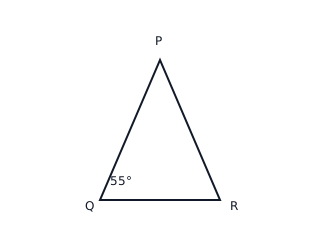
In , and . Find the measure of .
Solution:
- Since , is an isosceles triangle.
- In an isosceles triangle, angles opposite to equal sides are equal. Therefore, .
- Using the Angle Sum Property: .
- .
- .
- .
Explanation:
We identify the triangle as isosceles because two sides are equal. We equate the base angles and then subtract their sum from to find the vertex angle.
Problem 5:
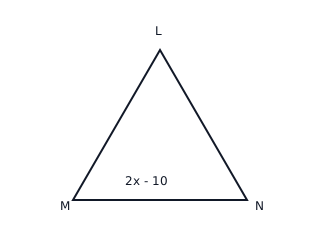
Find the value of in the given equilateral triangle where one angle is represented as .
Solution:
- In an equilateral triangle, every interior angle is equal to .
- Therefore, we can set up the equation: .
- .
- .
- .
Explanation:
Since all angles in an equilateral triangle are , any algebraic expression representing an angle can be equated to to solve for the variable.