
Review the key concepts, formulae, and examples before starting your quiz.
🔑Concepts
The Cartesian Coordinate Plane consists of two perpendicular axes: the horizontal x-axis and the vertical y-axis. Their intersection point is called the Origin, represented by . The plane is divided into four regions called quadrants, numbered I to IV in a counter-clockwise direction.
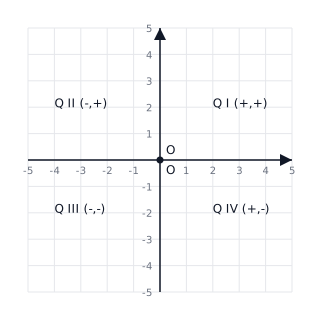
Points are located using ordered pairs . The first number (x-coordinate) tells you how far to move left or right from the origin. The second number (y-coordinate) tells you how far to move up or down. For example, moves 3 units right and 2 units down.
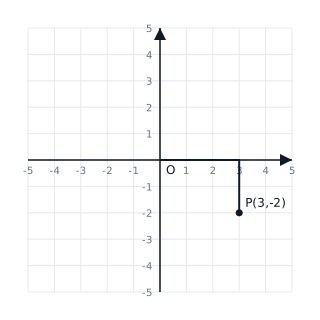
Reflections involve 'flipping' a point over an axis. Reflecting across the x-axis changes the sign of the y-coordinate . Reflecting across the y-axis changes the sign of the x-coordinate . This creates a mirror image relative to the chosen axis.
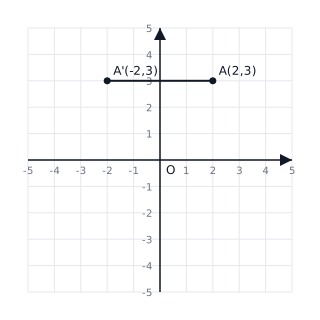
Distances between points on the same horizontal or vertical line can be found by calculating the absolute difference between the non-matching coordinates. For a vertical segment, distance .
📐Formulae
(when values are equal)
(when values are equal)
💡Examples
Problem 1:
Determine the coordinates and the quadrant for a point that is located units to the left of the y-axis and units above the x-axis.
Solution:
Step 1: Identify the x-coordinate. '5 units to the left' corresponds to an x-value of . Step 2: Identify the y-coordinate. '2 units above' corresponds to a y-value of . Step 3: Combine them into an ordered pair: . Step 4: Determine the quadrant. Since the x-coordinate is negative and the y-coordinate is positive , the point lies in Quadrant II.
Explanation:
We use the directional descriptions to assign signs to the coordinates and then apply the quadrant rules based on those signs.
Problem 2:
Find the distance between point and point .
Solution:
Step 1: Observe the coordinates. Both points have the same y-coordinate, which is . This means the points lie on a horizontal line. Step 2: Use the horizontal distance formula: . Step 3: Substitute the values: . Step 4: Calculate the absolute difference: . The distance is units.
Explanation:
Because the vertical position is identical, we only need to find how many units apart the points are along the horizontal x-axis.
Problem 3:
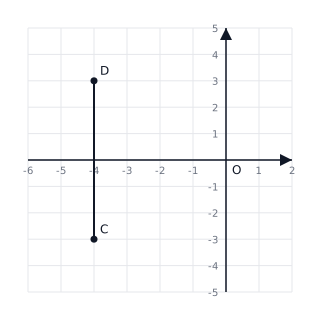
Point is at . If point is the reflection of point across the x-axis, find the coordinates of and calculate the vertical distance between and .
Solution:
- Reflection of across the x-axis keeps the x-coordinate same and negates the y-coordinate: .
- Distance units.
Explanation:
Reflecting over the x-axis moves the point from Quadrant III to Quadrant II. The vertical distance is the total units traveled from up to .
Problem 4:
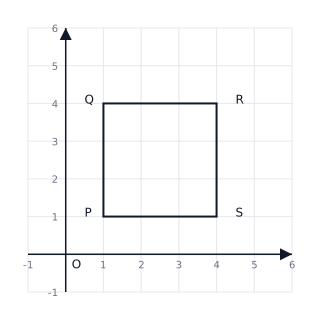
A square is drawn on a coordinate plane. Three of its vertices are , , and . Determine the coordinates of the fourth vertex and the side length of the square.
Solution:
- Observing the x-coordinates: and are on the line . and are on the line .
- To complete the square, must have the same x-coordinate as (which is ) and the same y-coordinate as (which is ). Thus, .
- Side length units.
Explanation:
In a square, adjacent sides are perpendicular. By matching the coordinates of the existing points, we find the point that closes the shape. The distance between and gives the side length of .