
Review the key concepts, formulae, and examples before starting your quiz.
🔑Concepts
The Radius () is the distance from the center of a circle to any point on its boundary, while the Diameter () is a straight line passing through the center connecting two points on the boundary.
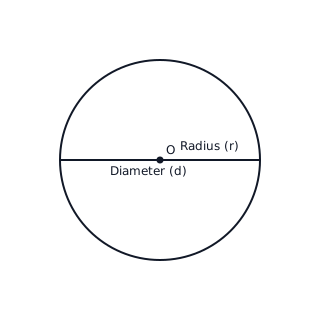
The Circumference () is the perimeter or distance around the circle. It is calculated using the formula or .
The Area () measures the region enclosed within the circle's boundary. It is calculated using the formula .
The constant (Pi) represents the ratio of the circumference to the diameter. For calculations, we commonly use or .
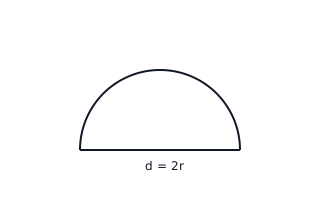
A Semicircle is exactly half of a circle. Its area is and its curved boundary is .
📐Formulae
or
💡Examples
Problem 1:
A circular clock has a radius of . Calculate its circumference. (Use )
Solution:
- Identify the given value: .
- Choose the circumference formula involving radius: .
- Substitute the values: .
- Simplify: The in the numerator and denominator cancel out, leaving .
- Calculate the final value: .
Explanation:
Since the radius is a multiple of , using the fraction for makes the calculation easier through cancellation.
Problem 2:
A circular garden has a diameter of . Find the total area of the garden. (Use )
Solution:
- Identify the given value: .
- Find the radius (): .
- Use the area formula: .
- Substitute the values: .
- Calculate the square: .
- Multiply: .
Explanation:
Always convert diameter to radius first before calculating area, as the area formula requires rather than .
Problem 3:
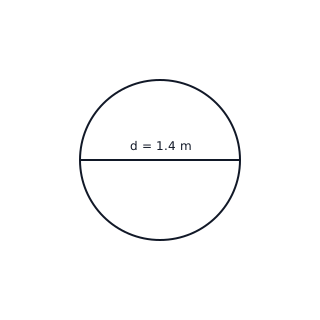
A circular table top has a diameter of . Find its circumference using .
Solution:
Given and .
Explanation:
To find the circumference when the diameter is known, we multiply the diameter by . Since is a multiple of (), using the fraction makes the calculation simpler.
Problem 4:
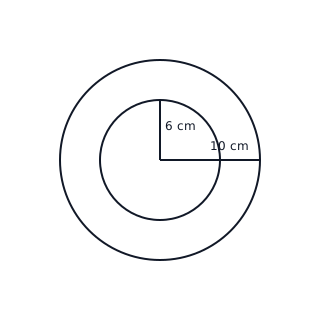
A circular ring has an inner radius of cm and an outer radius of cm. Calculate the area of the shaded region (the ring) between the two circles. (Use )
Solution:
Explanation:
To find the area of the ring (annulus), we calculate the area of the larger circle and subtract the area of the smaller inner circle. Both calculations use the formula .