
Review the key concepts, formulae, and examples before starting your quiz.
🔑Concepts
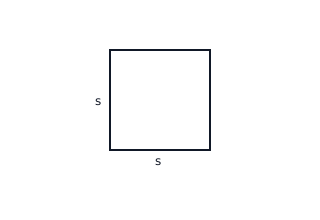
The area of a square is the space inside its boundaries. Since all sides are equal (), the area is calculated by squaring the side length: .
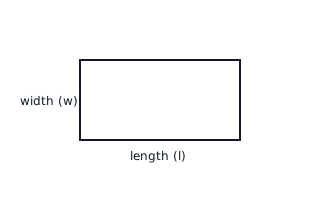
The area of a rectangle is found by multiplying its length () by its width (). This represents the number of unit squares that fit inside the shape.
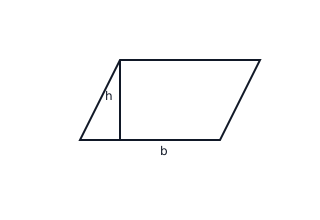
The area of a parallelogram is calculated using the base () and the perpendicular height (). If you 'cut off' a triangle from one side and move it to the other, the parallelogram becomes a rectangle of the same area.
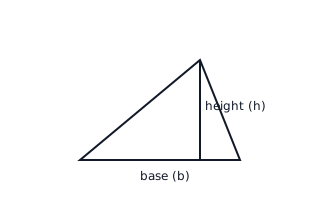
The area of a triangle is exactly half the area of a rectangle or parallelogram with the same base () and height (). Thus, .
📐Formulae
💡Examples
Problem 1:
A parallelogram has a base of and a perpendicular height of . Find its area.
Solution:
- Identify the formula for the area of a parallelogram:
- Substitute the given values into the formula:
- Multiply the numbers:
- State the final answer with square units:
Explanation:
To find the area of a parallelogram, we multiply the base by the perpendicular height. We do not use the slanted side lengths if they are provided.
Problem 2:
Calculate the area of a triangle that has a base of and a height of .
Solution:
- Write down the triangle area formula:
- Plug in the base () and height ():
- Multiply the base and height:
- Divide the result by 2:
- Add the correct units:
Explanation:
Since a triangle is half of a rectangle/parallelogram with the same base and height, we calculate the product of the base and height and then divide by two.
Problem 3:
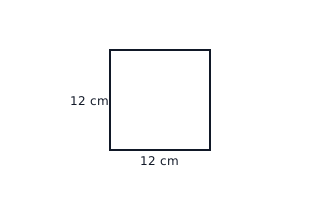
A square photo frame has a side length of . Calculate the total area of the frame.
Solution:
Explanation:
Since the shape is a square, we multiply the side length by itself to find the area.
Problem 4:
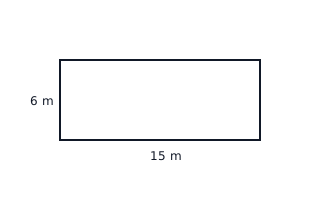
Find the area of a rectangle that has a length of and a width of .
Solution:
Explanation:
To find the area of a rectangle, multiply the length by the width.