
Review the key concepts, formulae, and examples before starting your quiz.
🔑Concepts
The First Quadrant is the top-right section of the coordinate plane where both (horizontal) and (vertical) values are positive. The origin is the starting point.
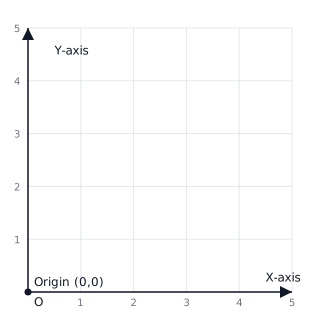
Coordinates are written as an ordered pair . The first number tells you how many units to move along the horizontal axis, and the second number tells you how many units to move up the vertical axis.
Distance between points can be calculated by counting grid units. If two points have the same -coordinate, the distance is the difference in -coordinates: . If they have the same -coordinate, it is .
A translation moves a shape or point. Adding to moves it right, subtracting from moves it left. Adding to moves it up, subtracting from moves it down.
📐Formulae
Coordinate Notation:
Translation (Right/Up):
Translation (Left/Down):
Horizontal Distance (same ):
Vertical Distance (same ):
💡Examples
Problem 1:
Point is located at . If Point is translated units to the right and units up to create Point , what are the coordinates of Point ?
Solution:
- Identify the starting coordinates: .
- Apply the horizontal translation (right): .
- Apply the vertical translation (up): .
- Write the new ordered pair: .
Explanation:
To move right, we add to the -coordinate. To move up, we add to the -coordinate. The point slides diagonally across the grid from to .
Problem 2:
A rectangle has four vertices. Three of the vertices are at , , and . What is the coordinate of the fourth vertex to complete the rectangle?
Solution:
- Look at the -coordinates: We have points at and .
- Look at the -coordinates: We have points at and .
- The missing point must share the -coordinate of the first point () and the -coordinate of the third point () to close the shape.
- The fourth vertex is .
Explanation:
In a rectangle on a coordinate plane, pairs of vertices must share the same or values to create perfectly horizontal and vertical sides.
Problem 3:
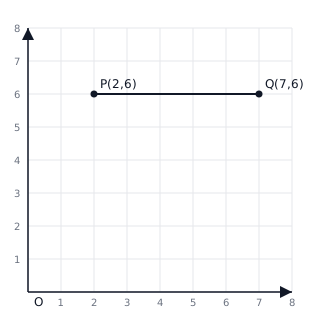
Calculate the length of the horizontal line segment connecting point and point .
Solution:
Explanation:
Since the -coordinates are both , the line is perfectly horizontal. To find the length, we subtract the smaller -coordinate from the larger -coordinate: .
Problem 4:
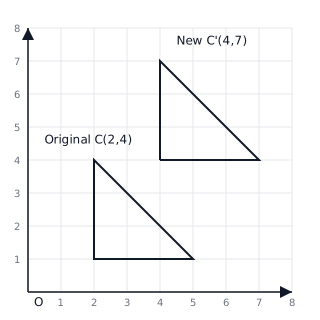
A triangle has vertices at , , and . If the triangle is translated units right and units up, what are the new coordinates of vertex ?
Solution:
Explanation:
To translate a point right, we add to the -coordinate (). To translate it up, we add to the -coordinate ().