
Review the key concepts, formulae, and examples before starting your quiz.
🔑Concepts
Triangles can be classified by their sides: Scalene (no equal sides), Isosceles (at least two equal sides), and Equilateral (all three sides equal). By angles, they are Acute (all angles ), Right (one angle ), or Obtuse (one angle ).
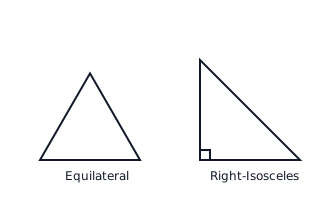
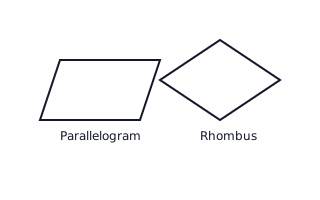
Quadrilaterals are four-sided polygons. Special types include Parallelograms (opposite sides parallel and equal), Rectangles (parallelograms with four right angles), Rhombuses (parallelograms with four equal sides), and Squares (four equal sides and four right angles).
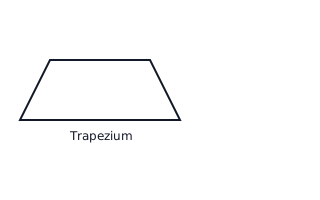
A Trapezium (or Trapezoid) is a quadrilateral with at least one pair of parallel sides. A Kite has two pairs of adjacent sides that are equal in length.
The sum of interior angles in any triangle is always , while the sum of interior angles in any quadrilateral is .
📐Formulae
Sum of angles in a triangle:
Sum of angles in a quadrilateral:
Perimeter of a Square:
Perimeter of a Rectangle:
Perimeter of any Triangle:
💡Examples
Problem 1:
A triangle has two angles that measure and . Calculate the size of the third angle and classify the triangle by its angles and sides.
Solution:
Step 1: Use the triangle angle sum formula: . Step 2: Add the known angles: . Step 3: Subtract from to find : . Step 4: Identify the properties. The angles are , , and .
Explanation:
Because one angle is (greater than ), it is an obtuse triangle. Because two angles are equal (), two sides must also be equal, making it an isosceles triangle. Result: Obtuse Isosceles Triangle.
Problem 2:
A quadrilateral has four equal sides. Its opposite angles are equal, but it does not have any right angles. Identify the shape and find the sum of its interior angles.
Solution:
Step 1: Analyze the properties. Four equal sides mean the shape is either a square or a rhombus. Step 2: Check the angles. Since there are no right angles (), it cannot be a square. Step 3: Conclude the shape is a Rhombus. Step 4: Use the quadrilateral angle sum rule.
Explanation:
A rhombus is a member of the parallelogram family. Like all quadrilaterals, the sum of its interior angles is always .
Problem 3:
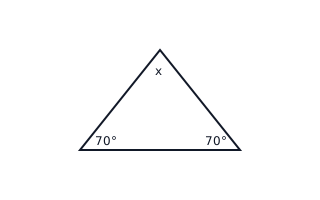
In the triangle shown, the angles at the base are each. Find the value of the third angle and classify the triangle by its sides.
Solution:
- Use the angle sum property: .
- .
- .
- Since two angles are equal (), the triangle is an Isosceles triangle.
Explanation:
Because two angles are equal, the sides opposite those angles must also be equal, which is the defining property of an isosceles triangle.
Problem 4:
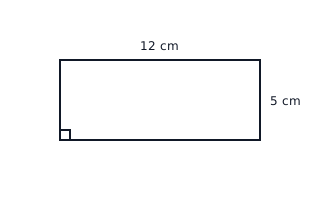
A rectangle has a length of and a width of . Calculate its perimeter and state the measure of each of its interior angles.
Solution:
- Perimeter .
- By definition, a rectangle has four right angles, so each interior angle is .
Explanation:
A rectangle is a special quadrilateral where opposite sides are equal and all internal angles are right angles ().