
Review the key concepts, formulae, and examples before starting your quiz.
🔑Concepts
A number sequence is an ordered list of numbers that follows a specific pattern or rule. In an increasing sequence, each term is larger than the previous one, often found by adding a constant value.
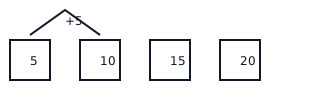
Repeating patterns use a core unit of shapes, colors, or numbers that repeats over and over. For example, a pattern repeats the pair .
Decreasing sequences are patterns where the numbers get smaller. This usually involves a 'Subtract' rule.
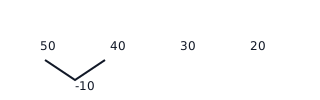
Function machines (Input/Output) apply a consistent rule to any number put into them. If the rule is , then an input of becomes an output of .
📐Formulae
💡Examples
Problem 1:
Identify the rule and find the next two numbers in the sequence:
Solution:
Step 1: Find the difference between the first two numbers: . Step 2: Check if this works for the next pair: . The rule is . Step 3: Add to the last known number: . Step 4: Add to that result: . The next two numbers are and .
Explanation:
To solve a growing pattern, calculate the difference between consecutive terms to find the constant addition rule.
Problem 2:
An Input/Output machine uses the rule 'Subtract '. If the Inputs are and , what are the corresponding Outputs?
Solution:
Step 1: Apply the rule to the first input: . Step 2: Apply the rule to the second input: . Step 3: Apply the rule to the third input: . The outputs are .
Explanation:
In a function machine, every input number is transformed by the same mathematical operation to produce an output.
Problem 3:
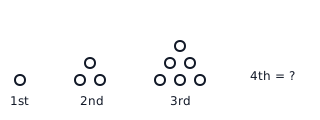
Observe the growing triangle pattern below. How many dots will be in the triangle in the sequence?
Solution:
The sequence of dots is The triangle has dot. The triangle has dots. The triangle has dots. Following the pattern, the triangle will have dots.
Explanation:
This is a growing pattern where we add , then , then to find the next term. These are known as triangular numbers.
Problem 4:
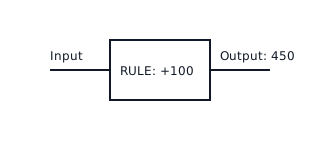
A function machine follows the rule 'Add '. If the machine produces the outputs and , what were the original inputs?
Solution:
Output Output Output The inputs were and .
Explanation:
To find the input when the output and rule are known, we perform the inverse (opposite) operation. The inverse of adding is subtracting .