
Review the key concepts, formulae, and examples before starting your quiz.
🔑Concepts
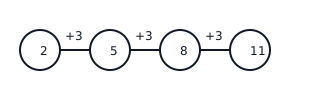
Arithmetic Patterns: A sequence of numbers where the difference between any two consecutive terms is constant. For example, in the pattern , the rule is to add .
Input-Output Machines: A function can be thought of as a machine. You put a number (input) in, a rule is applied, and a new number (output) comes out. If the input is and the rule is , the output is .

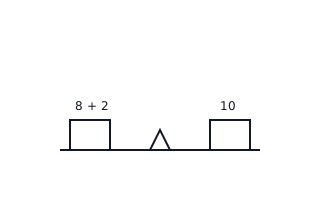
Equality and Balance: An equation is like a balanced scale. Both sides of the equal sign () must have the same value. If , then the scale is balanced.
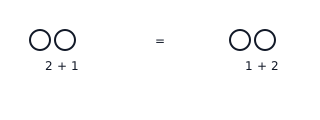
Commutative Property: In addition, changing the order of the numbers does not change the sum. For example, .
📐Formulae
(when rule is addition)
💡Examples
Problem 1:
Find the missing numbers in the following sequence:
Solution:
Step 1: Identify the rule by finding the difference between the first two numbers: . Step 2: Check if the rule applies to the next pair: . The rule is 'add '. Step 3: Add to the last known number to find the next one: . Step 4: Add to that result: . The sequence is .
Explanation:
To solve a growing pattern, we first determine the 'jump' or difference between numbers and then continue that same jump to find the unknown values.
Problem 2:
Solve for the missing value:
Solution:
Step 1: Understand that is the total and is one part. Step 2: To find the missing part, subtract the known part from the total: . Step 3: Calculate the subtraction: , and . So, . Step 4: Verify by checking if .
Explanation:
This problem uses the concept of part-part-whole. If we know the whole () and one part (), we subtract to find the missing part.
Problem 3:
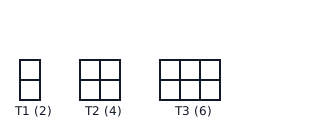
Identify the rule and find the 5th term in the following geometric pattern represented by squares: Term 1 has 2 squares, Term 2 has 4 squares, Term 3 has 6 squares.
Solution:
Explanation:
Each step adds 2 more squares than the previous one. To find any term, we multiply the term number by 2. For the 5th term, .
Problem 4:
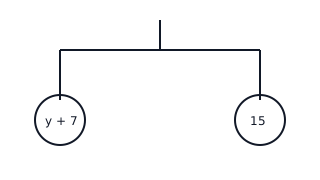
Determine the value of the unknown variable in the equation represented by the balanced hanger: .
Solution:
Explanation:
The hanger is balanced, meaning the left side equals the right side. To find the unknown , we subtract the known amount () from the total ().