
Review the key concepts, formulae, and examples before starting your quiz.
🔑Concepts
The Volume and Surface Area of a Cylinder depend on the radius and the perpendicular height . The Total Surface Area includes both the curved face (a rectangle when unrolled) and the two circular ends.
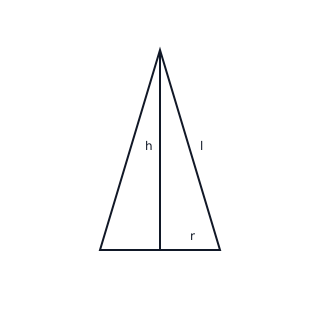
A Right Circular Cone is defined by its radius , vertical height , and slant height . These three lengths form a right-angled triangle, such that .
For mathematically similar solids, the ratio of their volumes is the cube of the ratio of their corresponding lengths:
A composite solid is formed by joining two or more basic 3D shapes. To find the total volume, sum the volumes of the individual parts. To find the surface area, ensure you subtract the 'hidden' faces where the shapes meet.
📐Formulae
Cuboid: ;
Cylinder: ; ;
Cone: ; (where is slant height )
Sphere: ;
Pyramid:
Similar Solids: and
💡Examples
Problem 1:
A solid toy is made of a hemisphere of radius 3 cm topped by a cone of the same radius and a height of 4 cm. Calculate the total volume of the toy.
Solution:
Explanation:
To find the volume of a composite solid, calculate the volume of each component part separately and sum them. Note that the volume of a hemisphere is half that of a sphere.
Problem 2:
Two mathematically similar cylinders have heights of 5 cm and 10 cm. If the smaller cylinder has a surface area of 40 cm², find the surface area of the larger cylinder.
Solution:
. Therefore, Area Ratio .
Explanation:
When objects are similar, the ratio of their areas is the square of the ratio of their corresponding linear dimensions (the scale factor ).
Problem 3:
A cone has a radius of 5 cm and a perpendicular height of 12 cm. Find its curved surface area.
Solution:
.
Explanation:
To find the Curved Surface Area of a cone, you must first find the slant height () using Pythagoras' theorem with the radius () and the vertical height ().
Problem 4:
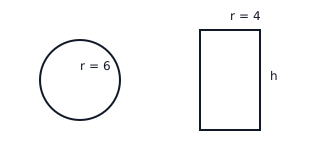
A spherical ball of radius cm is melted down and recast into a cylinder with a radius of cm. Calculate the height of the cylinder.
Solution:
Since the volume remains constant: Set the volumes equal:
Explanation:
Calculate the volume of the sphere first using . Since the material is recast, the volume of the cylinder must be equal to the volume of the sphere. Solve for in the cylinder volume formula.
Problem 5:
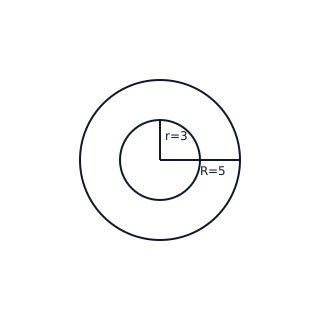
A hollow pipe is cm long. The external radius is cm and the internal radius is cm. Calculate the volume of the material used to make the pipe.
Solution:
Explanation:
To find the volume of a hollow cylinder, subtract the volume of the inner empty cylinder from the volume of the outer cylinder.