
Review the key concepts, formulae, and examples before starting your quiz.
🔑Concepts
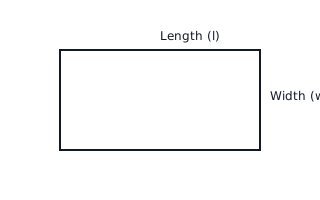
The perimeter is the total distance around the boundary of a 2D shape. For rectilinear shapes, it is the sum of all side lengths. For a circle, this distance is called the circumference.
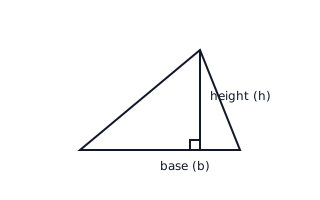
The area of a triangle is half the product of its base and its perpendicular height (). Note that the height must be measured at right angles to the base.
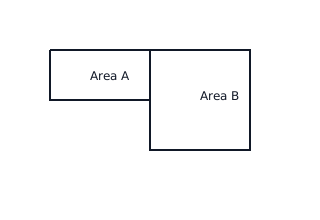
Compound shapes are made up of two or more basic shapes. To find the total area, split the shape into rectangles, triangles, or circles, calculate their individual areas, and add them together.
A sector is a portion of a circle defined by two radii and an arc. Its area and arc length are proportional to the central angle as a fraction of .
📐Formulae
💡Examples
Problem 1:
Calculate the area of a trapezium where the parallel sides are 12 cm and 18 cm, and the perpendicular height is 7 cm.
Solution:
Explanation:
Identify the parallel sides 'a' and 'b' and the height 'h'. Substitute them into the trapezium formula: Area = 1/2(sum of parallel sides) × height.
Problem 2:
Find the perimeter of a sector with a radius of 10 cm and a central angle of . (Take )
Solution:
. .
Explanation:
To find the perimeter of a sector, you must calculate the arc length first and then add the two radii that form the 'v' shape of the sector.
Problem 3:
A circular hole of radius 3 cm is cut out of a square piece of metal with side length 10 cm. Find the area of the remaining metal.
Solution:
. . .
Explanation:
This is a compound area problem involving subtraction. Calculate the total area of the outer shape (square) and subtract the area of the shape removed (circle).
Problem 4:
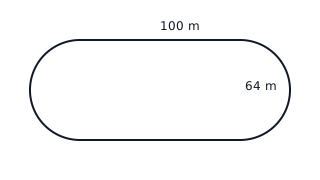
A running track consists of a rectangle with semi-circular ends. The rectangle has a length of m and a width of m. Calculate the total distance around the inside of the track. (Use )
Solution:
Explanation:
The boundary consists of two straight lengths of m and two semi-circular arcs. The two semi-circles combine to form one full circle with a diameter equal to the width of the rectangle ( m).
Problem 5:
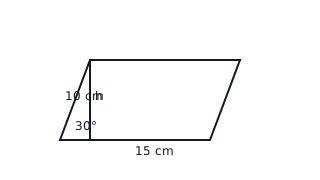
Calculate the area of a parallelogram with a base of cm and a slanted side of cm, where the angle between the base and the slanted side is .
Solution:
First, find the perpendicular height using trigonometry: Now, calculate the area:
Explanation:
The area of a parallelogram is . If the perpendicular height is not given, it can be calculated using the slanted side and the interior angle using .