
Review the key concepts, formulae, and examples before starting your quiz.
🔑Concepts
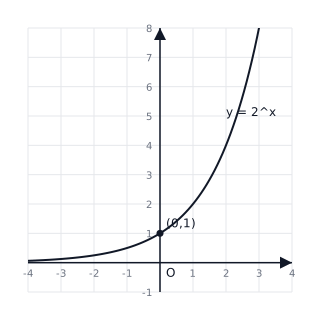
The exponential function (where ) represents growth, while or represents decay. These functions have a horizontal asymptote at .
The logarithmic function is the inverse of the exponential function. Its graph is a reflection of across the line . It has a vertical asymptote at and passes through .
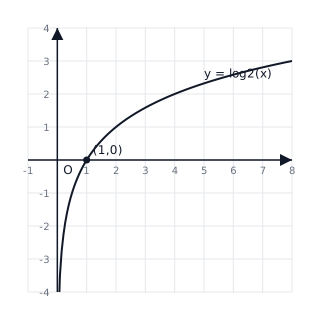
Natural logarithms use base (Euler's number ). The function and its inverse are central to calculus and model continuous growth processes.
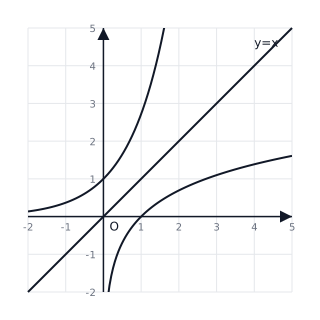
Logarithms convert multiplicative relationships into additive ones, allowing for the solution of equations where the variable is in the exponent by taking the log of both sides.
📐Formulae
(Product Rule)
(Quotient Rule)
(Power Rule)
and
(Change of Base)
and
💡Examples
Problem 1:
Solve for : . Give your answer to 3 decimal places.
Solution:
Explanation:
To solve an exponential equation where the bases cannot be made the same, take the logarithm of both sides. Use the power rule to bring the exponent down, then isolate using algebraic manipulation.
Problem 2:
Simplify the expression: .
Solution:
.
Explanation:
First, apply the Power Rule to move the coefficient into the exponent. Then, use the Quotient Rule for logarithms to combine the terms. Finally, evaluate the resulting logarithm.
Problem 3:
Solve the equation: .
Solution:
. Thus, or . However, must be for the logs to be defined, so .
Explanation:
Use the Product Rule to combine the logarithms into a single term. Convert the logarithmic equation into its equivalent exponential form (). Solve the resulting quadratic equation and always check for extraneous solutions (logs of negative numbers are undefined).
Problem 4:
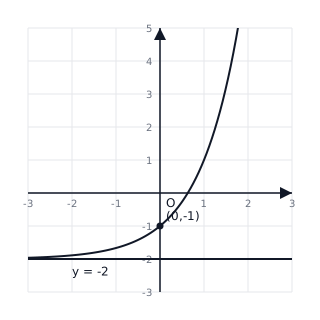
Sketch the graph of and identify the horizontal asymptote and the -intercept.
Solution:
- The base function is , which passes through .
- The transformation shifts the graph downwards by 2 units.
- The original horizontal asymptote becomes .
- To find the -intercept, set : .
- The -intercept is .
Explanation:
Exponential functions of the form have a horizontal asymptote at . The vertical shift affects all points and the asymptote equally.
Problem 5:
The power in a circuit is related to time by . Find the value of when the power drops to units.
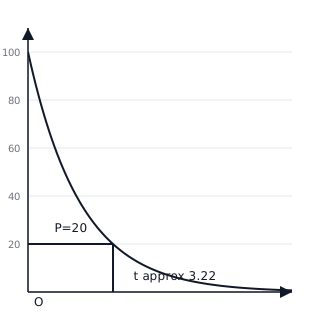
Solution:
- Set up the equation: .
- Divide by 100: .
- Take the natural logarithm of both sides: .
- Solve for : .
- .
Explanation:
To solve for a variable in the exponent of , use the natural logarithm because .