
Review the key concepts, formulae, and examples before starting your quiz.
🔑Concepts
A function maps an input from the domain to an output in the range. The inverse function reverses this process, mapping back to . This is only possible if the function is one-to-one (bijective).

The graph of an inverse function is a reflection of the graph of in the line . If a point lies on , then the point lies on .
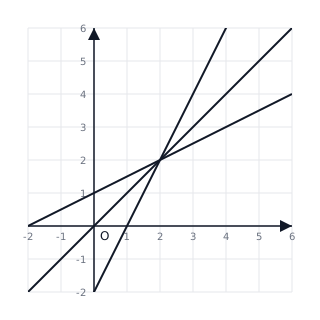
Composite functions involve applying one function to the result of another. For , the inner function is evaluated first, and its output becomes the input for the outer function . Note that in most cases.
To solve equations involving composites, such as , first define the expression for by substituting into , then solve the resulting algebraic equation for .
📐Formulae
(Composite Function)
(Identity Property)
(Identity Property)
To find : Set , swap and , then solve for .
💡Examples
Problem 1:
Given and , find and .
Solution:
. .
Explanation:
Substitute the entire expression of the inner function into every instance of 'x' in the outer function. Note that in most cases.
Problem 2:
Find the inverse of the function where .
Solution:
- Let
- Swap and :
- Multiply by :
- Expand:
- Rearrange to group :
- Factor out :
- Solve for : . Therefore, .
Explanation:
The method involves switching the roles of and and using algebraic manipulation to isolate the new as the subject.
Problem 3:
If , solve the equation .
Solution:
- Find : .
- Find : . So .
- Set them equal: .
- Solve: .
Explanation:
Calculate the numerical value of first, then equate it to the derived inverse function to solve for the unknown .
Problem 4:
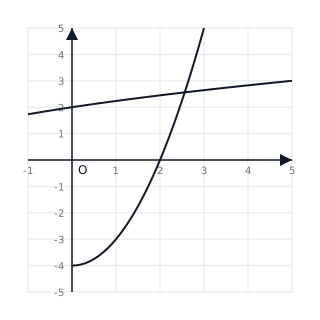
Given the functions and for , prove that is the inverse of for the domain by finding and .
Solution:
- Find :
- Find : (since ) Since , .
Explanation:
If the composition of two functions results in the identity function , the functions are inverses of each other. The domain restriction ensures is one-to-one.
Problem 5:
Let and . Find the value of the constant such that .

Solution:
- Calculate :
- Calculate :
- Set them equal:
Explanation:
To make the composition commutative, we find expressions for both orders of composition and equate the constant terms since the coefficients of are already equal.