krit.club logo

Calculus - Derivatives of Composite, Implicit, Inverse Trigonometric, Exponential and Logarithmic Functions

Grade 12ICSE

Review the key concepts, formulae, and examples before starting your quiz.

🔑Concepts

•

The Chain Rule (Composite Functions): If a function is composed of an outer function ff and an inner function gg, such that y=f(g(x))y = f(g(x)), its derivative is the product of the derivative of the outer function with respect to the inner function and the derivative of the inner function with respect to xx: dydx=f′(g(x))⋅g′(x)\frac{dy}{dx} = f'(g(x)) \cdot g'(x). This is visualized as peeling layers of an onion.

Flowchart representing composite function layers for the chain rule.
•

Logarithmic Differentiation: For functions of the form y=[f(x)]g(x)y = [f(x)]^{g(x)}, we take the natural logarithm on both sides to transform the exponent into a product: ln⁡y=g(x)ln⁡(f(x))\ln y = g(x) \ln(f(x)). Differentiating both sides implicitly yields 1ydydx=ddx[g(x)ln⁡(f(x))]\frac{1}{y} \frac{dy}{dx} = \frac{d}{dx}[g(x) \ln(f(x))]. This method is also useful for products and quotients involving multiple factors.
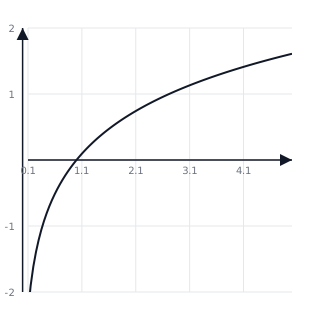
Graph of the natural logarithm function used in logarithmic differentiation.
•

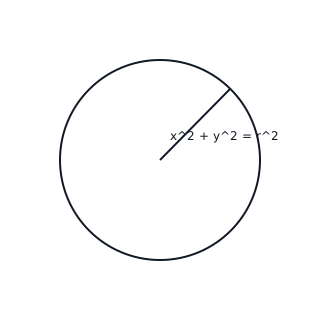
Implicit Differentiation: When yy is not explicitly defined as a function of xx (e.g., x2+y2=r2x^2 + y^2 = r^2), differentiate every term with respect to xx, treating yy as a function of xx and applying the chain rule to terms involving yy (i.e., ddx(yn)=nyn−1dydx\frac{d}{dx}(y^n) = ny^{n-1} \frac{dy}{dx}). Finally, solve the resulting equation for dydx\frac{dy}{dx}.

Geometric representation of an implicit circle equation.
•

Derivatives of Inverse Trigonometric Functions: These derivatives result in algebraic expressions. For instance, ddx(tan⁡−1x)=11+x2\frac{d}{dx}(\tan^{-1} x) = \frac{1}{1+x^2}. They are frequently used in integration and solving problems involving rates of change of angles.
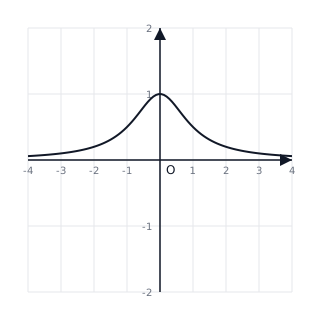
Plot of the derivative of the inverse tangent function.

📐Formulae

ddx[f(g(x))]=f′(g(x))⋅g′(x)\frac{d}{dx}[f(g(x))] = f'(g(x)) \cdot g'(x)

ddx(ex)=ex\frac{d}{dx}(e^x) = e^x

ddx(ax)=axln⁡a\frac{d}{dx}(a^x) = a^x \ln a

ddx(ln⁡x)=1x\frac{d}{dx}(\ln x) = \frac{1}{x}

ddx(log⁡ax)=1xln⁡a\frac{d}{dx}(\log_a x) = \frac{1}{x \ln a}

ddx(sin⁡−1x)=11−x2\frac{d}{dx}(\sin^{-1} x) = \frac{1}{\sqrt{1-x^2}}

ddx(cos⁡−1x)=−11−x2\frac{d}{dx}(\cos^{-1} x) = -\frac{1}{\sqrt{1-x^2}}

ddx(tan⁡−1x)=11+x2\frac{d}{dx}(\tan^{-1} x) = \frac{1}{1+x^2}

ddx(cot⁡−1x)=−11+x2\frac{d}{dx}(\cot^{-1} x) = -\frac{1}{1+x^2}

ddx(sec⁡−1x)=1∣x∣x2−1\frac{d}{dx}(\sec^{-1} x) = \frac{1}{|x|\sqrt{x^2-1}}

💡Examples

Problem 1:

Find dydx\frac{dy}{dx} if y=(sin⁡x)cos⁡xy = (\sin x)^{\cos x}.

Solution:

  1. Take the natural log of both sides: ln⁡y=ln⁡((sin⁡x)cos⁡x)\ln y = \ln ((\sin x)^{\cos x})
  2. Use log properties: ln⁡y=cos⁡x⋅ln⁡(sin⁡x)\ln y = \cos x \cdot \ln(\sin x)
  3. Differentiate both sides with respect to xx using the Product Rule on the right: 1ydydx=ddx(cos⁡x)⋅ln⁡(sin⁡x)+cos⁡x⋅ddx(ln⁡(sin⁡x))\frac{1}{y} \frac{dy}{dx} = \frac{d}{dx}(\cos x) \cdot \ln(\sin x) + \cos x \cdot \frac{d}{dx}(\ln(\sin x))
  4. Compute derivatives: 1ydydx=−sin⁡xln⁡(sin⁡x)+cos⁡x⋅1sin⁡x⋅cos⁡x\frac{1}{y} \frac{dy}{dx} = -\sin x \ln(\sin x) + \cos x \cdot \frac{1}{\sin x} \cdot \cos x
  5. Simplify: 1ydydx=−sin⁡xln⁡(sin⁡x)+cos⁡xcot⁡x\frac{1}{y} \frac{dy}{dx} = -\sin x \ln(\sin x) + \cos x \cot x
  6. Multiply by yy: dydx=y[cos⁡xcot⁡x−sin⁡xln⁡(sin⁡x)]\frac{dy}{dx} = y [\cos x \cot x - \sin x \ln(\sin x)]
  7. Substitute original yy: dydx=(sin⁡x)cos⁡x[cos⁡xcot⁡x−sin⁡xln⁡(sin⁡x)]\frac{dy}{dx} = (\sin x)^{\cos x} [\cos x \cot x - \sin x \ln(\sin x)]

Explanation:

This problem uses logarithmic differentiation because the function has a variable in both the base and the exponent. Taking ln⁡\ln converts the exponentiation into a product, which is then solvable via the Product Rule and Chain Rule.

Problem 2:

Find dydx\frac{dy}{dx} for the implicit equation x2+xy+y2=10x^2 + xy + y^2 = 10.

Solution:

  1. Differentiate both sides with respect to xx: ddx(x2)+ddx(xy)+ddx(y2)=ddx(10)\frac{d}{dx}(x^2) + \frac{d}{dx}(xy) + \frac{d}{dx}(y^2) = \frac{d}{dx}(10)
  2. Apply the Product Rule to xyxy and Chain Rule to y2y^2: 2x+(xdydx+y⋅1)+2ydydx=02x + (x \frac{dy}{dx} + y \cdot 1) + 2y \frac{dy}{dx} = 0
  3. Group terms containing dydx\frac{dy}{dx}: xdydx+2ydydx=−2x−yx \frac{dy}{dx} + 2y \frac{dy}{dx} = -2x - y
  4. Factor out dydx\frac{dy}{dx}: dydx(x+2y)=−(2x+y)\frac{dy}{dx}(x + 2y) = -(2x + y)
  5. Solve for dydx\frac{dy}{dx}: dydx=−2x+yx+2y\frac{dy}{dx} = -\frac{2x + y}{x + 2y}

Explanation:

This example demonstrates implicit differentiation. Since yy cannot be easily isolated, we differentiate term-by-term. The term xyxy requires the product rule, and y2y^2 requires the chain rule (multiplying by dydx\frac{dy}{dx}).

Problem 3:

Differentiate y=esin⁡(x2)y = e^{\sin(x^2)} with respect to xx.

Nested layers of the composite function exp(sin(x^2)).

Solution:

Let u=sin⁡(x2)u = \sin(x^2) and v=x2v = x^2. Then y=euy = e^u. Using the Chain Rule: dydx=dydu⋅dudv⋅dvdx\frac{dy}{dx} = \frac{dy}{du} \cdot \frac{du}{dv} \cdot \frac{dv}{dx} Step 1: dydu=eu=esin⁡(x2)\frac{dy}{du} = e^u = e^{\sin(x^2)} Step 2: dudv=cos⁡(v)=cos⁡(x2)\frac{du}{dv} = \cos(v) = \cos(x^2) Step 3: dvdx=2x\frac{dv}{dx} = 2x Combining the results: dydx=esin⁡(x2)⋅cos⁡(x2)⋅2x=2xcos⁡(x2)esin⁡(x2)\frac{dy}{dx} = e^{\sin(x^2)} \cdot \cos(x^2) \cdot 2x = 2x \cos(x^2) e^{\sin(x^2)}

Explanation:

This problem requires a nested application of the chain rule. We differentiate from the outermost layer (exponential) to the innermost layer (polynomial).

Problem 4:

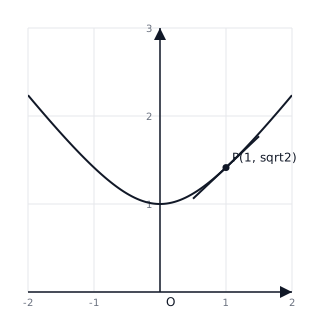
Find dydx\frac{dy}{dx} for the function y=x2+1y = \sqrt{x^2 + 1} at x=1x = 1.

Graph of y = sqrt(x^2+1) showing the tangent at x=1.

Solution:

Rewrite the function as y=(x2+1)1/2y = (x^2 + 1)^{1/2}. Apply the chain rule: dydx=12(x2+1)−1/2⋅ddx(x2+1)\frac{dy}{dx} = \frac{1}{2}(x^2 + 1)^{-1/2} \cdot \frac{d}{dx}(x^2 + 1) dydx=12x2+1⋅(2x)\frac{dy}{dx} = \frac{1}{2\sqrt{x^2 + 1}} \cdot (2x) dydx=xx2+1\frac{dy}{dx} = \frac{x}{\sqrt{x^2 + 1}} At x=1x = 1: dydx=112+1=12\frac{dy}{dx} = \frac{1}{\sqrt{1^2 + 1}} = \frac{1}{\sqrt{2}}

Explanation:

The derivative represents the slope of the tangent line to the curve. By substituting x=1x=1 into the derivative, we find the specific slope at that point.