
Calculus - Applications of Derivatives: Rate of Change, Increasing/Decreasing Functions, Tangents and Normals, Maxima and Minima
Review the key concepts, formulae, and examples before starting your quiz.
🔑Concepts
The derivative represents the instantaneous rate of change of with respect to . If is displacement and is time, the first derivative is velocity, and the second derivative is acceleration.
For a curve , the slope of the tangent at a point is given by . The normal is perpendicular to the tangent, so its slope is .
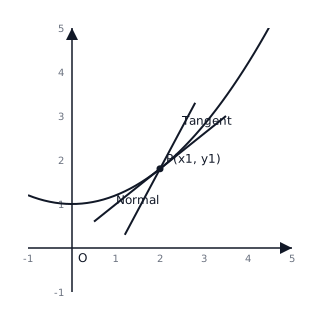
A function is strictly increasing on an interval if for all in that interval, meaning the graph moves upwards as increases. Conversely, it is strictly decreasing if .
Local maxima and minima (stationary points) occur where . The Second Derivative Test states that if and , is a local maximum. If , is a local minimum.
📐Formulae
Rate of Change:
Velocity: and Acceleration:
Slope of Tangent ():
Equation of Tangent:
Slope of Normal ():
Equation of Normal:
Condition for Increasing Function:
Condition for Decreasing Function:
Critical Point Condition: or is not defined
💡Examples
Problem 1:
Find the equations of the tangent and the normal to the curve at the point where .
Solution:
Step 1: Find the -coordinate at . . So, the point is . Step 2: Find the derivative to get the slope. . Step 3: Calculate the slope at . . Step 4: Equation of the tangent. Using : . Step 5: Equation of the normal. Slope of normal . Using : .
Explanation:
To find tangent and normal equations, first determine the point of contact, then use the derivative to find the tangent's slope. The normal's slope is the negative reciprocal of the tangent's slope.
Problem 2:
Find the local maximum and minimum values of the function .
Solution:
Step 1: Find the first derivative and set it to zero. . Setting . Step 2: Use the second derivative test. . Step 3: Test . . Since , is a point of local minimum. Local minimum value . Step 4: Test . . Since , is a point of local maximum. Local maximum value .
Explanation:
Critical points are found where the first derivative is zero. The second derivative test is then applied: a positive result indicates a minimum (valley), and a negative result indicates a maximum (peak).
Problem 3:
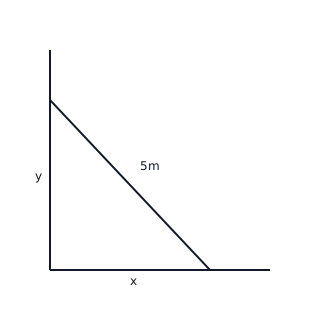
A ladder m long is leaning against a wall. The bottom of the ladder is pulled along the ground, away from the wall, at the rate of cm/s. How fast is its height on the wall decreasing when the foot of the ladder is m away from the wall?
Solution:
Let be the distance of the foot from the wall and be the height of the ladder on the wall. By Pythagoras theorem: Differentiating with respect to time : Given cm/s m/s. When : m. Substitute values: m/s. The height is decreasing at cm/s.
Explanation:
We use the Pythagorean relation to link the horizontal and vertical distances, then use implicit differentiation with respect to time to find the related rate of change.
Problem 4:
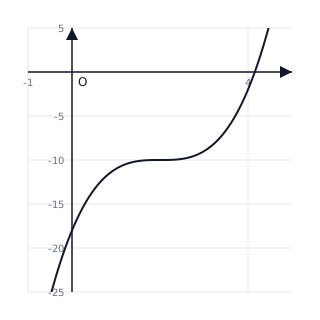
Show that the function is increasing on .
Solution:
First, find the derivative of the function: Factor out : This is a perfect square: Since for all , then for all real . Therefore, is an increasing function on .
Explanation:
To prove a function is increasing, we show that its first derivative is non-negative for all values in the domain.