
Review the key concepts, formulae, and examples before starting your quiz.
🔑Concepts
One-to-One (Injective) Function: A function is called injective if the images of distinct elements of under are distinct. Mathematically, for all . Geometrically, any horizontal line intersects the graph of a one-to-one function at most once.
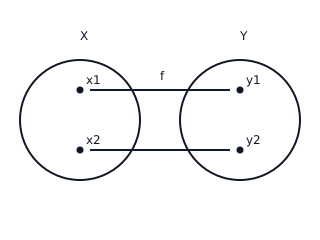
Onto (Surjective) Function: A function is surjective if every element of is the image of at least one element of under . In other words, the Range of is equal to the Codomain .
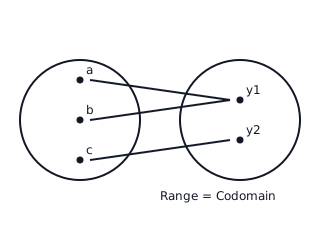
Many-to-One Function: A function is many-to-one if two or more distinct elements in have the same image in . For example, for is many-to-one because .
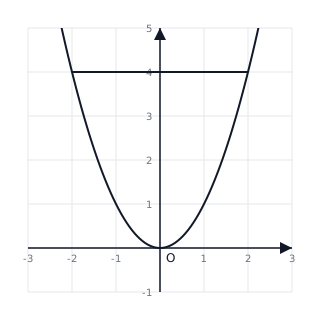
Bijective Function: A function is bijective (or a one-to-one correspondence) if it is both injective (one-to-one) and surjective (onto). A bijection ensures that every element in is paired with exactly one element in .
📐Formulae
💡Examples
Problem 1:
Show that the function , defined as , is bijective.
Solution:
- Injectivity: Let for . Then . Thus, is injective.
- Surjectivity: Let (codomain). We need to find such that . So, . Since is a real number, is also a real number. Therefore, for every , there exists such that . Thus, is surjective. Since is both injective and surjective, it is bijective.
Explanation:
To prove bijectivity, we must algebraically prove the function is both one-to-one (by equating images) and onto (by expressing in terms of ).
Problem 2:
Check the injectivity of the function defined by .
Solution:
Let where . Since , cannot be zero. Therefore, . Hence, the function is injective.
Explanation:
In the domain of Natural Numbers (), is injective because we cannot have negative values that would produce the same square as a positive value.
Problem 3:
Is the function defined by surjective?
Solution:
The codomain is (all real numbers). The range of is . Since there are negative numbers in the codomain (e.g., ) that have no pre-image (since has no real solution), the range is not equal to the codomain. . Therefore, is not surjective.
Explanation:
Surjectivity fails if any element in the codomain lacks a corresponding value in the domain. Squares of real numbers are never negative.
Problem 4:
Check the injectivity and surjectivity of the function defined by .
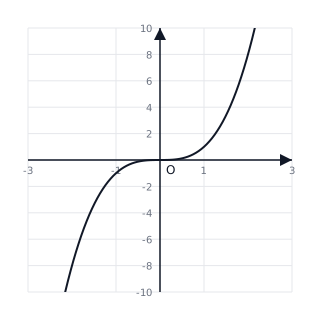
Solution:
- Injectivity: Let . If , then . Taking the cube root of both sides, we get . Thus, is injective.
- Surjectivity: Let (codomain). We need to find such that . Since , and every real number has a real cube root, . Thus, is surjective. Since is both injective and surjective, it is bijective.
Explanation:
The cubic function is strictly increasing, which ensures each y-value is mapped to exactly once. The range is the entire real line.
Problem 5:
Determine if the function defined by is onto.
![Graph of cos(x) showing that values outside [-1, 1] are not reached by the function.](https://s3.ap-south-1.amazonaws.com/prod-kritclub/science-diagrams/739ec0548d429efb366a9dc073357d7107420ad059e6847edabf0dc6a3b3000a.svg)
Solution:
Consider the codomain and the range of the function. We know that for any , . Therefore, the Range of is . Since the Range is not equal to the Codomain (elements like have no pre-image), the function is not surjective (not onto).
Explanation:
A function is onto only if its range equals its codomain. For trigonometric functions, the range is often a subset of real numbers.