
Relations and Functions - Types of relations: reflexive, symmetric, transitive and equivalence relations
Review the key concepts, formulae, and examples before starting your quiz.
🔑Concepts
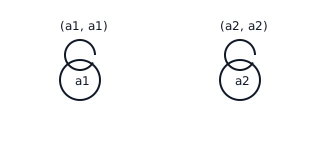
A relation on set is Reflexive if every element maps to itself. Mathematically, . In a directed graph representation, this means every node has a self-loop.
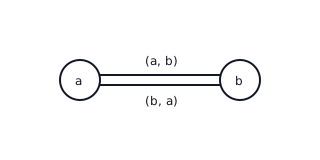
A relation is Symmetric if for every pair , the reverse pair is also in . If there is an arrow from to , there must be one from back to .
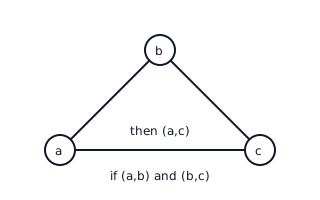
A relation is Transitive if and implies . Visually, if you can go from to via , a direct path from to must exist.
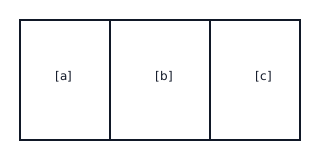
An Equivalence Relation is a relation that is simultaneously reflexive, symmetric, and transitive. It partitions the set into disjoint subsets called Equivalence Classes.
📐Formulae
Total number of relations from set to set :
Total number of relations on a set with elements:
Reflexive Relation Condition:
Symmetric Relation Condition:
Transitive Relation Condition:
Equivalence Class of :
Number of reflexive relations on a set of elements:
💡Examples
Problem 1:
Let be the set of all triangles in a plane with a relation in given by (where denotes congruence). Show that is an equivalence relation.
Solution:
- Reflexive: For any triangle , (every triangle is congruent to itself). Thus, for all . is reflexive.
- Symmetric: Let . This implies . Since congruence is symmetric, . Therefore, . is symmetric.
- Transitive: Let and . This means and . By the property of congruence, . Therefore, . is transitive. Since is reflexive, symmetric, and transitive, it is an equivalence relation.
Explanation:
To prove an equivalence relation, we must independently verify the three properties (Reflexive, Symmetric, and Transitive) using the definition of the given relation (congruence of triangles).
Problem 2:
Let be the set of integers and be a relation defined by . Prove is an equivalence relation.
Solution:
- Reflexive: For any , . Since divides , . Hence, is reflexive.
- Symmetric: Let . Then for some integer . Multiplying by , . Since is an integer, divides . Thus . is symmetric.
- Transitive: Let and . Then and for integers . Adding these: . Since is an integer, divides . Thus . is transitive.
Explanation:
This demonstrates the properties using algebraic manipulation. The relation effectively partitions integers into two equivalence classes: even and odd numbers.
Problem 3:
Let be the set of all lines in a plane and be the relation in defined as . Show that is an equivalence relation.

Solution:
- Reflexive: Every line is parallel to itself (). Thus, .
- Symmetric: If , then . Thus, .
- Transitive: If and , then . Thus, and . Since is reflexive, symmetric, and transitive, it is an equivalence relation.
Explanation:
The relation of being parallel satisfies all three criteria. Note that for lines, we consider a line parallel to itself to satisfy reflexivity.
Problem 4:
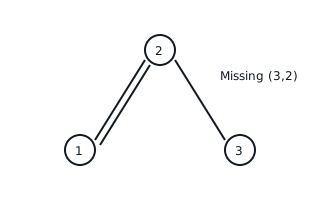
Check if the relation on the set defined as is an equivalence relation.
Solution:
- Reflexive: . So, it is reflexive.
- Symmetric: and . However, but . Therefore, it is not symmetric.
- Transitive: and , but . Therefore, it is not transitive. Since it is not symmetric and not transitive, it is not an equivalence relation.
Explanation:
For a relation to be an equivalence relation, it must satisfy all three properties. Failing even one (like symmetry here) disqualifies it.