krit.club logo

Determinants - Minors, co-factors and applications of determinants in finding the area of a triangle

Grade 12CBSE

Review the key concepts, formulae, and examples before starting your quiz.

🔑Concepts

•

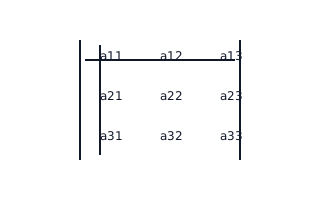
The minor of an element aija_{ij} in a determinant Δ\Delta is the determinant obtained by deleting its ithi^{th} row and jthj^{th} column. For a 3×33 \times 3 determinant, each minor is a 2×22 \times 2 determinant.

Visualizing the minor of element a11 by striking out the first row and first column.
•

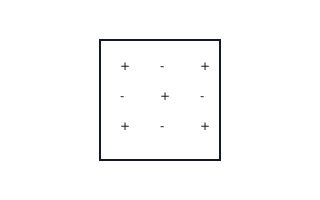
A cofactor AijA_{ij} is the minor MijM_{ij} multiplied by a sign factor (−1)i+j(-1)^{i+j}. The signs follow a checkerboard pattern: positive for i+ji+j even and negative for i+ji+j odd.

Cofactor sign pattern for a 3x3 determinant.
•

The area of a triangle with vertices (x1,y1)(x_1, y_1), (x2,y2)(x_2, y_2), and (x3,y3)(x_3, y_3) is given by 12\frac{1}{2} times the absolute value of the determinant of the coordinates. Since area is always positive, take the absolute value of the result.
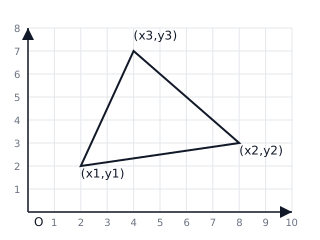
Triangle on a coordinate plane representing vertices used in the determinant area formula.
•

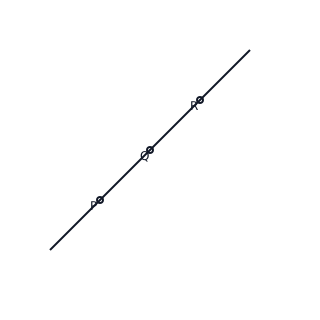
If three points are collinear (lie on the same straight line), they do not form a triangle. Consequently, the area of the 'triangle' they would form is zero, making the corresponding determinant value zero.
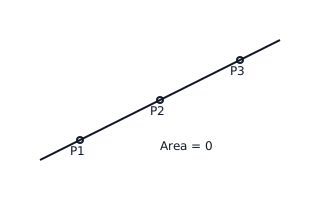
Three collinear points illustrating that the determinant of their coordinates equals zero.
•

The determinant of a matrix can be expanded along any row or column. The sum of products of elements of any row (or column) with their corresponding cofactors equals the value of the determinant.

Flowchart showing determinant expansion using cofactors.

📐Formulae

Minor of aij=Mija_{ij} = M_{ij}

Cofactor Aij=(−1)i+jMijA_{ij} = (-1)^{i+j} M_{ij}

Value of determinant Δ=∑j=13aijAij\Delta = \sum_{j=1}^{3} a_{ij} A_{ij} (along any row ii)

Area of Triangle = 12∣∣x1y11x2y21x3y31∣∣\frac{1}{2} | \begin{vmatrix} x_1 & y_1 & 1 \\ x_2 & y_2 & 1 \\ x_3 & y_3 & 1 \end{vmatrix} |

Collinearity Condition: ∣x1y11x2y21x3y31∣=0\begin{vmatrix} x_1 & y_1 & 1 \\ x_2 & y_2 & 1 \\ x_3 & y_3 & 1 \end{vmatrix} = 0

Equation of a line through (x1,y1)(x_1, y_1) and (x2,y2)(x_2, y_2): ∣xy1x1y11x2y21∣=0\begin{vmatrix} x & y & 1 \\ x_1 & y_1 & 1 \\ x_2 & y_2 & 1 \end{vmatrix} = 0

💡Examples

Problem 1:

Find the minors and cofactors of all elements of the determinant Δ=∣1−243∣\Delta = \begin{vmatrix} 1 & -2 \\ 4 & 3 \end{vmatrix}.

Solution:

  1. For element a11=1a_{11} = 1: Minor M11=3M_{11} = 3, Cofactor A11=(−1)1+1(3)=3A_{11} = (-1)^{1+1}(3) = 3.
  2. For element a12=−2a_{12} = -2: Minor M12=4M_{12} = 4, Cofactor A12=(−1)1+2(4)=−4A_{12} = (-1)^{1+2}(4) = -4.
  3. For element a21=4a_{21} = 4: Minor M21=−2M_{21} = -2, Cofactor A21=(−1)2+1(−2)=2A_{21} = (-1)^{2+1}(-2) = 2.
  4. For element a22=3a_{22} = 3: Minor M22=1M_{22} = 1, Cofactor A22=(−1)2+2(1)=1A_{22} = (-1)^{2+2}(1) = 1.

Explanation:

To find the minor, we hide the row and column of the element. To find the cofactor, we multiply the minor by (−1)i+j(-1)^{i+j} based on the element's position.

Problem 2:

Find the area of the triangle whose vertices are (3,8)(3, 8), (−4,2)(-4, 2), and (5,1)(5, 1).

Solution:

The area Δ\Delta is given by: Δ=12∣∣381−421511∣∣\Delta = \frac{1}{2} | \begin{vmatrix} 3 & 8 & 1 \\ -4 & 2 & 1 \\ 5 & 1 & 1 \end{vmatrix} | Expanding along R1R_1: Δ=12∣3(2−1)−8(−4−5)+1(−4−10)∣\Delta = \frac{1}{2} | 3(2 - 1) - 8(-4 - 5) + 1(-4 - 10) | Δ=12∣3(1)−8(−9)+1(−14)∣\Delta = \frac{1}{2} | 3(1) - 8(-9) + 1(-14) | Δ=12∣3+72−14∣\Delta = \frac{1}{2} | 3 + 72 - 14 | Δ=12∣61∣=30.5\Delta = \frac{1}{2} | 61 | = 30.5 sq. units.

Explanation:

We use the coordinate-based determinant formula for the area of a triangle. Expanding along the first row simplifies the calculation, and we take the absolute value of the final result.

Problem 3:

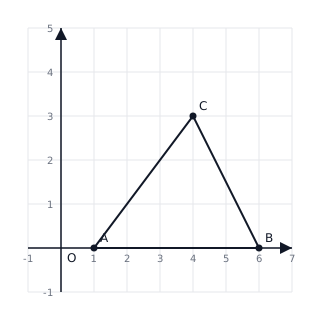
Find the area of the triangle whose vertices are A(1,0)A(1, 0), B(6,0)B(6, 0) and C(4,3)C(4, 3) using determinants.

Triangle with vertices A(1,0), B(6,0), C(4,3)

Solution:

The area is given by: Area=12∣∣101601431∣∣\text{Area} = \frac{1}{2} \left| \begin{vmatrix} 1 & 0 & 1 \\ 6 & 0 & 1 \\ 4 & 3 & 1 \end{vmatrix} \right| Expanding along the second column (which contains two zeros): Area=12∣−0+0−3(1−6)∣\text{Area} = \frac{1}{2} | -0 + 0 - 3(1 - 6) | Area=12∣−3(−5)∣\text{Area} = \frac{1}{2} | -3(-5) | Area=12∣15∣=7.5 sq. units\text{Area} = \frac{1}{2} | 15 | = 7.5 \text{ sq. units}

Explanation:

To simplify calculation, expand along the column or row with the most zeros. Here, column 2 is used.

Problem 4:

Show that the points P(a,b+c)P(a, b+c), Q(b,c+a)Q(b, c+a) and R(c,a+b)R(c, a+b) are collinear.

Three points lying on a single straight line demonstrating collinearity

Solution:

The points are collinear if the determinant of their coordinates is zero: Δ=∣ab+c1bc+a1ca+b1∣\Delta = \begin{vmatrix} a & b+c & 1 \\ b & c+a & 1 \\ c & a+b & 1 \end{vmatrix} Applying C2→C1+C2C_2 \to C_1 + C_2: Δ=∣aa+b+c1ba+b+c1ca+b+c1∣\Delta = \begin{vmatrix} a & a+b+c & 1 \\ b & a+b+c & 1 \\ c & a+b+c & 1 \end{vmatrix} Taking (a+b+c)(a+b+c) common from C2C_2: Δ=(a+b+c)∣a11b11c11∣\Delta = (a+b+c) \begin{vmatrix} a & 1 & 1 \\ b & 1 & 1 \\ c & 1 & 1 \end{vmatrix} Since columns C2C_2 and C3C_3 are identical, the determinant is 00. Thus, the points are collinear.

Explanation:

Properties of determinants (identical columns) help prove collinearity efficiently.