krit.club logo

Determinants - Area of a Triangle

Grade 12CBSE

Review the key concepts, formulae, and examples before starting your quiz.

πŸ”‘Concepts

β€’

The area of a triangle with vertices (x1,y1)(x_1, y_1), (x2,y2)(x_2, y_2), and (x3,y3)(x_3, y_3) can be calculated using a determinant. The absolute value must be taken because area is a non-negative quantity.
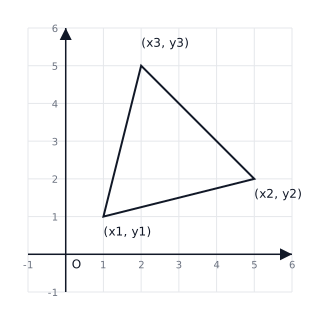
A triangle plotted on a coordinate plane with vertices labeled as (x1, y1), (x2, y2), and (x3, y3).
β€’

Since the determinant can be positive or negative, we always use the absolute value of the determinant for finding the area. Conversely, if the area is given, use both positive and negative values of the determinant for calculations.

β€’

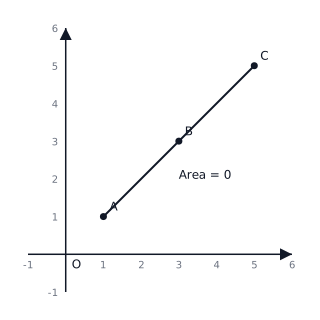
Three points (x1,y1)(x_1, y_1), (x2,y2)(x_2, y_2), and (x3,y3)(x_3, y_3) are collinear if the area of the triangle formed by them is zero. This happens when the determinant evaluates to exactly 00.

Three points A, B, and C lying on a single straight line, indicating collinearity and zero area.
β€’

The equation of a line passing through two points (x1,y1)(x_1, y_1) and (x2,y2)(x_2, y_2) can be found by setting the determinant of a matrix containing a general point (x,y)(x, y) and the two given points to zero.

β€’

When expanding the determinant 12[x1(y2βˆ’y3)βˆ’y1(x2βˆ’x3)+1(x2y3βˆ’x3y2)]\frac{1}{2} [x_1(y_2 - y_3) - y_1(x_2 - x_3) + 1(x_2 y_3 - x_3 y_2)], the result matches the coordinate geometry formula for the area of a triangle.

πŸ“Formulae

AreaΒ ofΒ Ξ”=12∣∣x1y11x2y21x3y31∣∣\text{Area of } \Delta = \frac{1}{2} \left| \begin{vmatrix} x_1 & y_1 & 1 \\ x_2 & y_2 & 1 \\ x_3 & y_3 & 1 \end{vmatrix} \right|

Condition for collinearity: ∣x1y11x2y21x3y31∣=0\text{Condition for collinearity: } \begin{vmatrix} x_1 & y_1 & 1 \\ x_2 & y_2 & 1 \\ x_3 & y_3 & 1 \end{vmatrix} = 0

Equation of line passing through (x1,y1) and (x2,y2):∣xy1x1y11x2y21∣=0\text{Equation of line passing through } (x_1, y_1) \text{ and } (x_2, y_2): \begin{vmatrix} x & y & 1 \\ x_1 & y_1 & 1 \\ x_2 & y_2 & 1 \end{vmatrix} = 0

πŸ’‘Examples

Problem 1:

Find the area of the triangle with vertices (3,8)(3, 8), (βˆ’4,2)(-4, 2), and (5,1)(5, 1) using determinants.

Solution:

Area=12∣381βˆ’421511∣\text{Area} = \frac{1}{2} \begin{vmatrix} 3 & 8 & 1 \\ -4 & 2 & 1 \\ 5 & 1 & 1 \end{vmatrix} Expanding along the first row: =12[3(2βˆ’1)βˆ’8(βˆ’4βˆ’5)+1(βˆ’4βˆ’10)]= \frac{1}{2} [ 3(2 - 1) - 8(-4 - 5) + 1(-4 - 10) ] =12[3(1)βˆ’8(βˆ’9)+1(βˆ’14)]= \frac{1}{2} [ 3(1) - 8(-9) + 1(-14) ] =12[3+72βˆ’14]=612=30.5Β sq.Β units= \frac{1}{2} [ 3 + 72 - 14 ] = \frac{61}{2} = 30.5 \text{ sq. units}

Explanation:

Substitute the coordinates into the determinant formula and expand it along any row or column (usually the first row). Take the absolute value of the final result.

Problem 2:

Find the value of kk if the area of the triangle is 44 square units and the vertices are (k,0)(k, 0), (4,0)(4, 0), and (0,2)(0, 2).

Solution:

The area is given as 44. We use Β±4\pm 4 for the determinant value: 12∣k01401021∣=Β±4\frac{1}{2} \begin{vmatrix} k & 0 & 1 \\ 4 & 0 & 1 \\ 0 & 2 & 1 \end{vmatrix} = \pm 4 Expanding along the second column (as it has two zeros): 12[βˆ’2(kβˆ’4)]=Β±4\frac{1}{2} [ -2(k - 4) ] = \pm 4 βˆ’(kβˆ’4)=Β±4-(k - 4) = \pm 4 Case 1: βˆ’(kβˆ’4)=4β€…β€ŠβŸΉβ€…β€Šβˆ’k+4=4β€…β€ŠβŸΉβ€…β€Šk=0-(k - 4) = 4 \implies -k + 4 = 4 \implies k = 0 Case 2: βˆ’(kβˆ’4)=βˆ’4β€…β€ŠβŸΉβ€…β€Šβˆ’k+4=βˆ’4β€…β€ŠβŸΉβ€…β€Šk=8-(k - 4) = -4 \implies -k + 4 = -4 \implies k = 8 Therefore, k=0,8k = 0, 8.

Explanation:

When the area is given, it is important to equate the determinant expression to both the positive and negative values of the area to find all possible values of the unknown variable.

Problem 3:

Find the equation of the line joining A(1,3)A(1, 3) and B(0,0)B(0, 0) using determinants.

Solution:

Let P(x,y)P(x, y) be any point on the line ABAB. Then the area of Ξ”PAB\Delta PAB is 00. ∣xy1131001∣=0\begin{vmatrix} x & y & 1 \\ 1 & 3 & 1 \\ 0 & 0 & 1 \end{vmatrix} = 0 Expanding along the third row: 0(yβˆ’3)βˆ’0(xβˆ’1)+1(3xβˆ’y)=00(y - 3) - 0(x - 1) + 1(3x - y) = 0 3xβˆ’y=03x - y = 0 or y=3xy = 3x

Explanation:

To find the equation of a line passing through two points, assume a general point (x,y)(x, y) on the line and set the determinant representing the area to zero since the three points are collinear.

Problem 4:

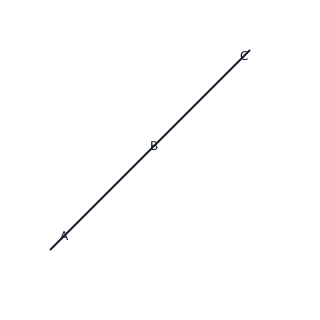
Show that the points A(a,b+c)A(a, b + c), B(b,c+a)B(b, c + a), and C(c,a+b)C(c, a + b) are collinear.

A straight line containing points A, B, and C indicating collinearity.

Solution:

To show collinearity, the determinant Ξ”\Delta must be zero. Ξ”=∣ab+c1bc+a1ca+b1∣\Delta = \begin{vmatrix} a & b + c & 1 \\ b & c + a & 1 \\ c & a + b & 1 \end{vmatrix} Applying column operation C2β†’C2+C1C_2 \to C_2 + C_1: Ξ”=∣aa+b+c1ba+b+c1ca+b+c1∣\Delta = \begin{vmatrix} a & a + b + c & 1 \\ b & a + b + c & 1 \\ c & a + b + c & 1 \end{vmatrix} Taking (a+b+c)(a + b + c) common from C2C_2: Ξ”=(a+b+c)∣a11b11c11∣\Delta = (a + b + c) \begin{vmatrix} a & 1 & 1 \\ b & 1 & 1 \\ c & 1 & 1 \end{vmatrix} Since C2C_2 and C3C_3 are identical, the determinant value is 00. Thus, points A,BA, B, and CC are collinear.

Explanation:

Collinearity is proven by showing that the area of the triangle formed by these three points is zero. Using determinant properties (identical columns) simplifies the proof.

Problem 5:

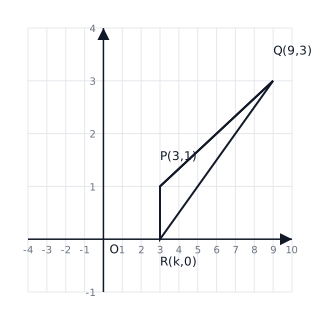
Find the equation of the line joining P(3,1)P(3, 1) and Q(9,3)Q(9, 3) using determinants. Also, find kk if R(k,0)R(k, 0) is a point such that the area of Ξ”PQR\Delta PQR is 33 sq units.

Line PQ and triangle PQR with vertex R on the x-axis.

Solution:

Let (x,y)(x, y) be any point on line PQPQ. The equation is: ∣xy1311931∣=0\begin{vmatrix} x & y & 1 \\ 3 & 1 & 1 \\ 9 & 3 & 1 \end{vmatrix} = 0 x(1βˆ’3)βˆ’y(3βˆ’9)+1(9βˆ’9)=0β€…β€ŠβŸΉβ€…β€Šβˆ’2x+6y=0β€…β€ŠβŸΉβ€…β€Šxβˆ’3y=0x(1 - 3) - y(3 - 9) + 1(9 - 9) = 0 \implies -2x + 6y = 0 \implies x - 3y = 0. Now, for point R(k,0)R(k, 0), Area =3= 3: 12∣∣311931k01∣∣=3\frac{1}{2} \left| \begin{vmatrix} 3 & 1 & 1 \\ 9 & 3 & 1 \\ k & 0 & 1 \end{vmatrix} \right| = 3 ∣311931k01∣=Β±6\begin{vmatrix} 3 & 1 & 1 \\ 9 & 3 & 1 \\ k & 0 & 1 \end{vmatrix} = \pm 6 Expanding along R3R_3: k(1βˆ’3)βˆ’0+1(9βˆ’9)=Β±6β€…β€ŠβŸΉβ€…β€Šβˆ’2k=Β±6k(1 - 3) - 0 + 1(9 - 9) = \pm 6 \implies -2k = \pm 6. So, k=3k = 3 or k=βˆ’3k = -3.

Explanation:

We first use the condition of collinearity with a variable point (x,y)(x,y) to find the line equation. Then, we use the area formula with the given absolute value of 3 to solve for the unknown coordinate kk.