
Application of Derivatives - Maximum and Minimum Values of a Function in a Closed Interval
Review the key concepts, formulae, and examples before starting your quiz.
🔑Concepts
The Absolute Maximum and Minimum values (also known as global extrema) of a continuous function on a closed interval always exist. Unlike local extrema, absolute extrema are found by comparing the function's values at critical points and the endpoints of the interval.
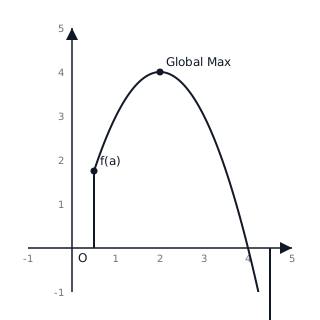
Step 1: Find all critical points of in the interval by solving or finding where does not exist.
Step 2: Calculate the value of the function at all the critical points found in Step 1 and at the endpoints and .
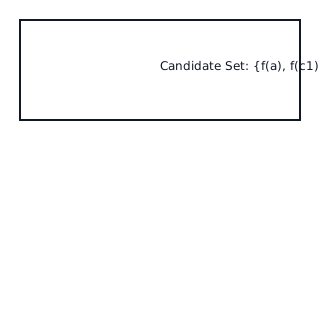
Step 3: The largest of these values is the Absolute Maximum value and the smallest is the Absolute Minimum value of on .

📐Formulae
💡Examples
Problem 1:
Find the absolute maximum and minimum values of the function on the interval .
Solution:
- Find the derivative:
- Set : Thus, critical points are and . Both lie in the interval .
- Evaluate at critical points and endpoints:
- Compare values:
- Absolute Maximum Value = at
- Absolute Minimum Value = at .
Explanation:
To find absolute extrema on a closed interval, we must check the function values at the critical points (where the slope is zero) and the boundaries of the interval. Even if a local maximum exists inside the interval (like at ), the endpoint value (at ) might be significantly higher.
Problem 2:
Find the absolute maximum and minimum values of on .
Solution:
- Find :
- Critical points: (Since ).
- Evaluate at :
- Conclusion:
- Absolute Maximum Value = at
- Absolute Minimum Value = at .
Explanation:
In trigonometric functions over a closed interval, the extreme values occur where the components balance out (critical points) or at the constraints of the domain (endpoints).
Problem 3:
Find the absolute maximum and minimum values of on the interval .
![Plot of x^4 - 8x^2 + 16 on [-3, 1] showing max at boundary and min at critical point.](https://s3.ap-south-1.amazonaws.com/prod-kritclub/science-diagrams/a01dbabb776e89181659d24fcfc2c0e759d9190a0116793b844450e3cfa3619a.svg)
Solution:
- Find : .
- Set : The critical points are .
- Check which points lie in : and are in the interval. is outside.
- Evaluate at endpoints and valid critical points:
- Compare: Absolute Max is at ; Absolute Min is at .
Explanation:
We identify critical points within the specified range and compare their functional values against the values at the boundary points and .
Problem 4:
Determine the absolute maximum and minimum of on the interval .
![Plot of 3x - x^3 on [0, 2] identifying max and min.](https://s3.ap-south-1.amazonaws.com/prod-kritclub/science-diagrams/3bae3d938c76977f71eca2668f95c18cc21ade95441e3c79b910db07baaaea6a.svg)
Solution:
- Find : .
- Set : .
- Check interval : Only is within the interval.
- Evaluate values:
- Compare: Absolute Maximum is at ; Absolute Minimum is at .
Explanation:
Calculus reveals a local peak at . By checking the boundaries, we find the function drops below zero at the right endpoint, making it the global minimum.