
Review the key concepts, formulae, and examples before starting your quiz.
🔑Concepts
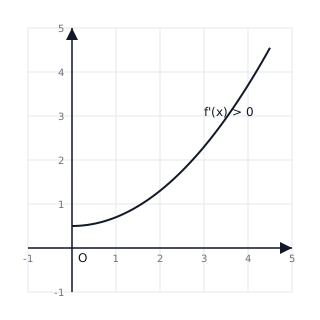
A function is called strictly increasing on an interval if for any two points in that interval, implies . Geometrically, the slope of the tangent at any point, given by , is positive ().
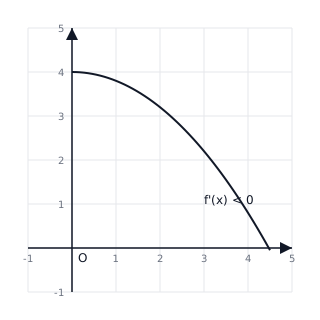
A function is called strictly decreasing on an interval if implies . In this case, the derivative is negative (), meaning the tangent to the curve makes an obtuse angle with the positive x-axis.
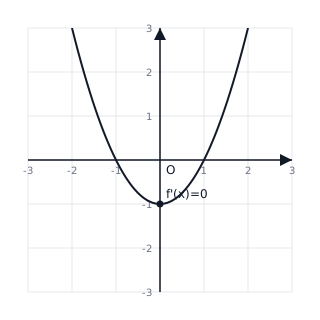
Critical points occur where or where is not differentiable. These points help in dividing the domain into intervals where the function maintains a constant sign for its derivative.
The First Derivative Test: If for all , then is strictly increasing in . If for all , then is strictly decreasing in .
📐Formulae
Strictly Increasing: for
Strictly Decreasing: for
Increasing: for
Decreasing: for
Constant Function: for all
💡Examples
Problem 1:
Find the intervals in which the function is strictly increasing or strictly decreasing.
Solution:
- Find the derivative: .
- Set to find the critical point: .
- The point divides the real line into two intervals: and .
- Test interval : Let . . Thus, is strictly decreasing on .
- Test interval : Let . . Thus, is strictly increasing on .
Explanation:
We use the First Derivative Test. By finding where the slope is positive or negative, we identify the direction of the function.
Problem 2:
Prove that the function is strictly decreasing in .
Solution:
- Differentiate the function: .
- Analyze the sign of in the given interval .
- In the first and second quadrants (i.e., ), the value of is always positive: .
- Therefore, will be negative: for all .
- Since , the function is strictly decreasing on .
Explanation:
Trigonometric functions are evaluated by checking the sign of their derivatives within specific quadrants of the unit circle.
Problem 3:
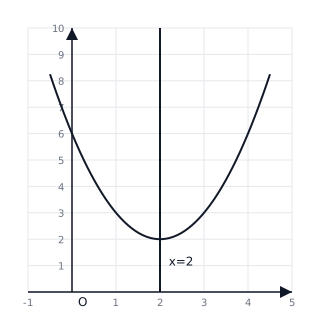
Find the intervals in which the function is (a) strictly increasing, (b) strictly decreasing.
Solution:
- Find the derivative: .
- Set to find critical points: .
- The point divides the real line into two intervals: and .
- For , let : . So, is strictly decreasing in .
- For , let : . So, is strictly increasing in .
Explanation:
We use the derivative to determine the slope. The critical point is where the function changes from decreasing to increasing.
Problem 4:
Determine the intervals in which is strictly increasing or decreasing.
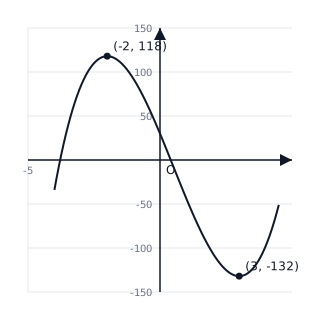
Solution:
- .
- Factorizing: .
- Critical points: .
- Intervals: , , and .
- In , (Strictly Increasing).
- In , (Strictly Decreasing).
- In , (Strictly Increasing).
Explanation:
By checking the signs of the factors and in each interval, we determine the overall sign of the derivative.