
Review the key concepts, formulae, and examples before starting your quiz.
🔑Concepts
The derivative of a function at a point represents the slope of the tangent line to the curve at that point. For a polynomial curve like , the slope changes continuously along the curve.
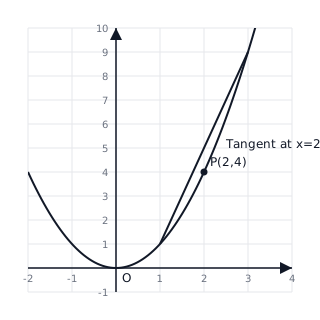
The Power Rule states that for any real number , . This allows for quick differentiation of terms like (becoming ) or (which is ).
Trigonometric functions exhibit periodic rates of change. The derivative of is , which means the slope of the sine wave at any point is given by the value of the cosine function at that same point.
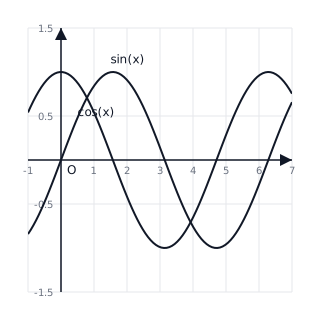
Linearity of Differentiation: The derivative of a sum of functions is the sum of their derivatives, and constants can be factored out.
📐Formulae
(where is a constant)
💡Examples
Problem 1:
Find the derivative of the polynomial function .
Solution:
Step 1: Apply the sum and difference rule to differentiate each term separately. Step 2: Use the power rule and constant rule. Term 1: Term 2: Term 3: Term 4: The derivative of the constant 12 is 0. Step 3: Combine the results.
Explanation:
We use the power rule for each power of . The constant multiple stays in front and multiplies the result of the power rule differentiation. The constant term disappears because its rate of change is zero.
Problem 2:
Differentiate the function with respect to .
Solution:
Step 1: Identify the trigonometric derivatives needed: and . Step 2: Apply the linearity rule to differentiate each trigonometric term. Step 3: Factor out the constants and substitute the derivatives. Step 4: Simplify the expression.
Explanation:
The derivatives of sine and cosine are cyclic but involve a sign change for the cosine derivative. The constants 2 and 5 are preserved as multipliers due to the constant multiple rule.
Problem 3:
Differentiate the function with respect to .
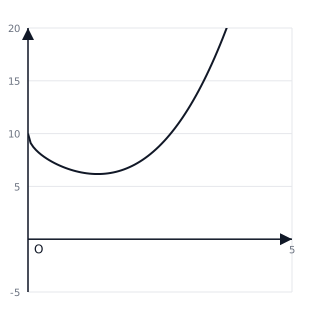
Solution:
- Rewrite the terms in power form:
- Apply the power rule to each term:
- Simplify the coefficients and exponents:
- Final form:
Explanation:
This example demonstrates using the power rule for integer and fractional exponents, along with the constant rule (the derivative of 10 is 0).
Problem 4:
Calculate the slope of the curve at the point where .
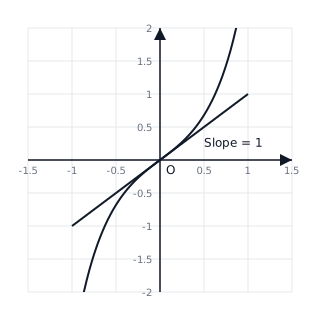
Solution:
- Find the general derivative :
- Use trigonometric derivative identities:
- Substitute into the derivative to find the slope:
- Evaluate trigonometric values: and The slope of the curve at is .
Explanation:
The derivative function provides the slope at any point. By substituting a specific value of , we find the instantaneous rate of change at that specific location.