krit.club logo

Calculus - Limits of Polynomials, Rational, Trigonometric, Exponential and Logarithmic Functions

Grade 11ICSE

Review the key concepts, formulae, and examples before starting your quiz.

🔑Concepts

Definition of a Limit: The limit of a function f(x)f(x) as xx approaches aa is the value LL that f(x)f(x) gets closer to from both the left side (xax \to a^{-}) and the right side (xa+x \to a^{+}). Visually, if you trace the graph from both sides, the yy-coordinates must converge toward the same height LL for the limit to exist, even if there is a 'hole' in the graph at x=ax = a.

Direct Substitution for Polynomials: For any polynomial function P(x)P(x), the limit as xax \to a is simply P(a)P(a). Visually, polynomial graphs are smooth, continuous curves without any breaks or jumps, meaning the value the function 'should' reach is exactly the value it 'does' reach.

Rational Functions and Indeterminate Forms: For a function f(x)g(x)\frac{f(x)}{g(x)}, if direct substitution results in 00\frac{0}{0}, it is called an indeterminate form. Visually, this usually signifies a removable discontinuity (a hole) in the graph. You must simplify the expression by factoring and canceling common terms before substituting the value again.

Limits of Trigonometric Functions: These involve specialized identities like limx0sinxx=1\lim_{x \to 0} \frac{\sin x}{x} = 1. Visually, as xx (measured in radians) gets closer to zero, the length of the vertical segment representing sinx\sin x on a unit circle becomes almost identical to the arc length xx, causing their ratio to approach 1.

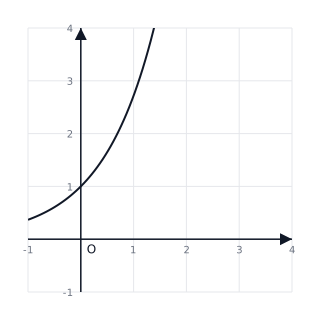
Exponential and Logarithmic Growth: These limits describe the behavior of growth functions near zero. For example, limx0ex1x=1\lim_{x \to 0} \frac{e^x - 1}{x} = 1. Visually, this indicates that the slope of the curve y=exy = e^x at the point (0,1)(0, 1) is exactly 1, meaning the curve is tangent to the line y=x+1y = x + 1 at that specific point.

Existence of a Limit: A limit exists at x=ax = a if and only if the Left-Hand Limit (LHL) equals the Right-Hand Limit (RHL), i.e., limxaf(x)=limxa+f(x)\lim_{x \to a^{-}} f(x) = \lim_{x \to a^{+}} f(x). If the graph shows a 'jump' (like a step function) where the left side ends at one height and the right side starts at another, the limit does not exist.

📐Formulae

limxa[f(x)±g(x)]=limxaf(x)±limxag(x)\lim_{x \to a} [f(x) \pm g(x)] = \lim_{x \to a} f(x) \pm \lim_{x \to a} g(x)

limxaxnanxa=nan1\lim_{x \to a} \frac{x^n - a^n}{x - a} = n a^{n-1}

limx0sinxx=1 (where x is in radians)\lim_{x \to 0} \frac{\sin x}{x} = 1 \text{ (where } x \text{ is in radians)}

limx0tanxx=1\lim_{x \to 0} \frac{\tan x}{x} = 1

limx01cosxx=0\lim_{x \to 0} \frac{1 - \cos x}{x} = 0

limx0ex1x=1\lim_{x \to 0} \frac{e^x - 1}{x} = 1

limx0ax1x=logea or lna\lim_{x \to 0} \frac{a^x - 1}{x} = \log_e a \text{ or } \ln a

limx0loge(1+x)x=1\lim_{x \to 0} \frac{\log_e(1+x)}{x} = 1

💡Examples

Problem 1:

Evaluate the limit: limx3x29x3\lim_{x \to 3} \frac{x^2 - 9}{x - 3}

Solution:

  1. Direct substitution gives 32933=00\frac{3^2 - 9}{3 - 3} = \frac{0}{0}, which is indeterminate.
  2. Factor the numerator: x29=(x3)(x+3)x^2 - 9 = (x - 3)(x + 3).
  3. Rewrite the limit: limx3(x3)(x+3)x3\lim_{x \to 3} \frac{(x - 3)(x + 3)}{x - 3}.
  4. Cancel the common factor (x3)(x - 3): limx3(x+3)\lim_{x \to 3} (x + 3).
  5. Substitute x=3x = 3: 3+3=63 + 3 = 6.

Explanation:

This is a rational function limit. Since substitution resulted in 0/00/0, we used the factorization method to remove the 'hole' at x=3x=3 and find the value the function was approaching.

Problem 2:

Evaluate the limit: limx0sin4x3x\lim_{x \to 0} \frac{\sin 4x}{3x}

Solution:

  1. We know the standard limit limθ0sinθθ=1\lim_{\theta \to 0} \frac{\sin \theta}{\theta} = 1.
  2. To make the argument of sine match the denominator, multiply and divide the expression by 4: 44sin4x3x\frac{4}{4} \cdot \frac{\sin 4x}{3x}.
  3. Rearrange the terms: 43sin4x4x\frac{4}{3} \cdot \frac{\sin 4x}{4x}.
  4. Apply the limit: 43limx0sin4x4x\frac{4}{3} \cdot \lim_{x \to 0} \frac{\sin 4x}{4x}.
  5. Since 4x04x \to 0 as x0x \to 0, the limit becomes 431=43\frac{4}{3} \cdot 1 = \frac{4}{3}.

Explanation:

This trigonometric limit is solved by manipulating the expression to match the standard identity sinθθ\frac{\sin \theta}{\theta}. We adjusted the denominator to match the angle 4x4x and extracted the constant coefficient.