
Review the key concepts, formulae, and examples before starting your quiz.
🔑Concepts
A linear inequality in two variables defines a half-plane in the Cartesian coordinate system. The boundary is the line . If the inequality is strict ( or ), the line is drawn dashed; if it is non-strict ( or ), the line is solid.
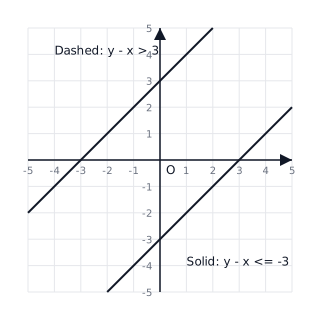
To determine which side of the boundary line to shade, we use a 'test point' not on the line, usually . If the coordinates satisfy the inequality, the half-plane containing is the solution region; otherwise, the opposite half-plane is chosen.
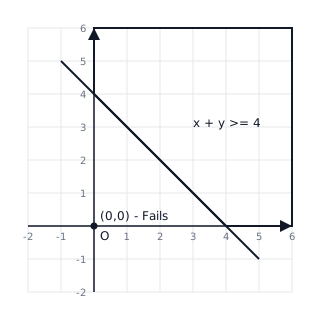
Horizontal inequalities or represent regions above or below a horizontal line, while vertical inequalities or represent regions to the right or left of a vertical line.
The solution to a system of linear inequalities is the intersection (overlapping area) of all the individual solution regions. This common region is called the feasible region.
📐Formulae
General form of linear inequalities: , , ,
Boundary line equation:
Slope-intercept form for plotting: , where
Intercept form for plotting:
Horizontal line inequality: (region below the line ) or (region above the line )
Vertical line inequality: (region to the left of line ) or (region to the right of line )
💡Examples
Problem 1:
Solve the linear inequality graphically.
Solution:
Step 1: Convert the inequality into an equation to find the boundary line: . \nStep 2: Find the intercepts. When (point ). When (point ). \nStep 3: Draw a dashed line passing through and because the inequality is strict (). \nStep 4: Use as a test point. Substitute into : . This is False. \nStep 5: Since the origin does not satisfy the inequality, shade the half-plane that does not contain the origin.
Explanation:
The solution is the region above the line , excluding the points on the line itself.
Problem 2:
Find the graphical solution for the system of inequalities: , , , .
Solution:
Step 1: For , intercepts are and . Draw a solid line. Testing gives (True), so shade towards the origin. \nStep 2: For , intercepts are and . Draw a solid line. Testing gives (False), so shade away from the origin. \nStep 3: and restrict the solution to the first quadrant. \nStep 4: Identify the common region where all conditions overlap.
Explanation:
The solution is a bounded quadrilateral region in the first quadrant with vertices determined by the intersection of the boundary lines.
Problem 3:
Solve the inequality graphically.
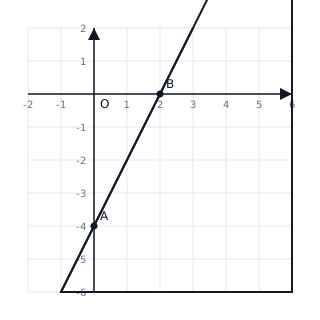
Solution:
- Write the boundary line equation: .
- Find intercepts: When (Point ). When (Point ).
- Draw a dashed line through and because the inequality is strict ().
- Test point : is False.
- Since the test point fails, shade the region that does NOT contain .
Explanation:
The boundary line splits the plane. Since results in a false statement, the solution set is the open half-plane on the side of the line opposite to the origin.
Problem 4:
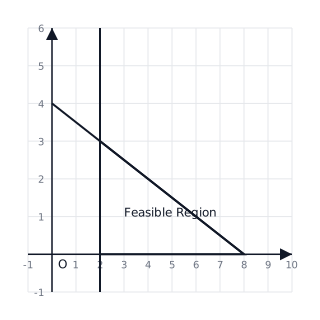
Solve the system of inequalities graphically: and .
Solution:
- For : Boundary is . Intercepts are and . Test : (True). Shade towards origin.
- For : Boundary is vertical line . Shade to the right of .
- The solution is the region satisfied by both.
Explanation:
The intersection of the half-plane below and the half-plane to the right of forms the solution area.