
Linear Inequalities - Algebraic Solutions of Linear Inequalities in One Variable and their Graphical Representation
Review the key concepts, formulae, and examples before starting your quiz.
🔑Concepts
A linear inequality in one variable is an expression involving algebraic terms with a degree of 1, separated by inequality signs such as or . Solving it means finding all real values of that make the statement true.
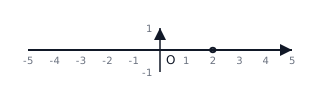
Equal numbers can be added to or subtracted from both sides of an inequality without changing the sign of the inequality. For example, if , then .

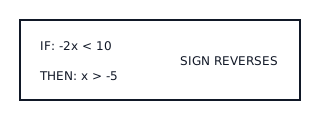
When both sides of an inequality are multiplied or divided by a positive number, the inequality sign remains the same. However, if multiplied or divided by a negative number, the inequality sign MUST be reversed.
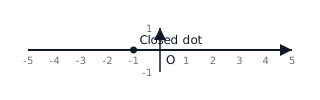
Graphical representation on a number line uses a dark circle (dot) for inclusive inequalities () and an open circle for strict inequalities (). The solution set is denoted by a thick line or arrow in the direction of the valid values.
📐Formulae
General forms: , , ,
If and is any real number, then and
If and , then and
If and , then and
Solution set for :
Solution set for :
💡Examples
Problem 1:
Solve the inequality and represent the solution on a number line.
Solution:
Step 1: Subtract from both sides: Step 2: Subtract 7 from both sides: Step 3: Divide by 2: or The solution set in interval notation is .
Explanation:
To solve, we isolate the variable by performing inverse operations. Since we did not multiply or divide by a negative number, the inequality sign direction remains the same throughout. On a number line, this would be shown by an open circle at and a shaded arrow pointing to the right.
Problem 2:
Solve for real .
Solution:
Step 1: Multiply both sides by the LCM of 5 and 3, which is 15: Step 2: Expand the brackets: Step 3: Add to both sides: Step 4: Add 18 to both sides: Step 5: Divide by 34: The solution set is .
Explanation:
We first eliminate the fractions by multiplying by the positive LCM. After simplifying the terms, we isolate . The 'less than or equal to' sign means 2 is included in the solution, represented by a solid circle on the number line at 2 with shading to the left.
Problem 3:
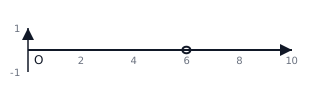
Solve the inequality and show the solution on a number line for real .
Solution:
The solution set is .
Explanation:
We group the variable terms on the left and the constant terms on the right. Dividing by a positive coefficient (2) does not change the inequality sign. Since is strictly less than 6, we use an open circle at 6.
Problem 4:
Solve the inequality for real .
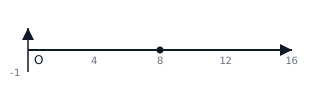
Solution:
Multiply both sides by 6 (LCM of 3 and 6): Divide by -5 and reverse the inequality sign: The solution set is .
Explanation:
After clearing fractions by multiplying by 6, we isolate . The final step involves dividing by a negative number (-5), which requires flipping the inequality sign from to . A solid dot is used at 8 to show it is included.