
Review the key concepts, formulae, and examples before starting your quiz.
🔑Concepts
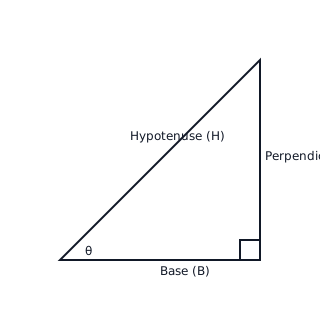
The fundamental trigonometric ratios are defined based on a right-angled triangle. For an angle , the side opposite to it is the perpendicular (), the side adjacent is the base (), and the longest side is the hypotenuse ().
The reciprocal identities connect sine with cosecant, cosine with secant, and tangent with cotangent. Multiplying a ratio by its reciprocal always equals 1, such as .

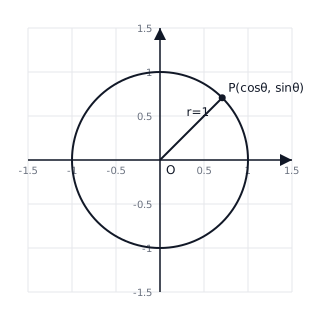
The Pythagorean Identity is derived from the Pythagorean theorem . On a unit circle (radius 1), the coordinates of any point are .
Quotient identities express tangent and cotangent in terms of sine and cosine: and . These are essential for simplifying complex expressions.
To prove identities, start from the more complex side (usually LHS) and use algebraic techniques like taking LCM, rationalization, or factoring alongside basic identities to reach the simpler side.
📐Formulae
💡Examples
Problem 1:
Prove that
Solution:
Step 1: Take the LHS and find the common denominator. Step 2: Expand the term using the identity . Step 3: Group and together. Step 4: Use the identity . Step 5: Factor out 2 from the numerator. Step 6: Cancel the common factor .
Explanation:
This problem is solved by using the algebraic technique of finding a common denominator and then applying the fundamental Pythagorean identity to simplify the numerator.
Problem 2:
Prove that
Solution:
Step 1: Start with the LHS and rationalize the denominator by multiplying the numerator and denominator by inside the square root. Step 2: Simplify the numerator and denominator. Step 3: Use the identity . Step 4: Remove the square root. Step 5: Split the fraction. Step 6: Apply reciprocal and quotient identities.
Explanation:
The key strategy here is 'rationalizing' the expression under the square root to create perfect squares in both the numerator and denominator, allowing the root to be removed.
Problem 3:
Prove that .

Solution:
LHS: Converting to and : Using :
Explanation:
This example demonstrates the strategy of converting secant and tangent into sine and cosine terms first. Then, the identity is used to factorize the denominator to cancel out common terms.
Problem 4:
Prove that .
Solution:
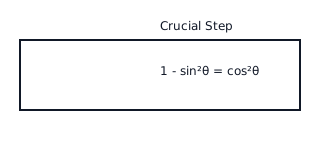
LHS: Taking LCM: Using :
Explanation:
To solve this, we combine the fractions by finding a common denominator. The denominator results in a difference of squares , which is transformed into using the primary Pythagorean identity.