
Review the key concepts, formulae, and examples before starting your quiz.
🔑Concepts
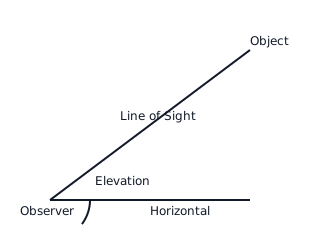
The Line of Sight is the path along which an observer looks at an object. If the object is above the horizontal level, we measure the Angle of Elevation; if below, we measure the Angle of Depression.
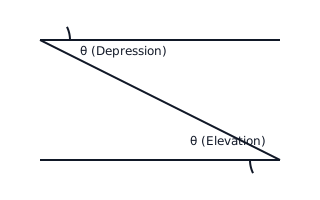
The Angle of Depression is equal to the Angle of Elevation from the object to the observer because the horizontal lines are parallel, creating alternate interior angles.
Right-angled trigonometry is the core tool: use for problems involving heights and distances along the ground.
For two-point problems, set up two equations using the same height or the same distance to solve for unknown variables.
📐Formulae
💡Examples
Problem 1:
The angle of elevation of the top of a tower from a point on the ground, which is m away from the foot of the tower, is . Find the height of the tower.
Solution:
Let be the height of the tower and be the distance from the point to the foot of the tower .
Given: Distance m Angle of elevation
In right-angled : m m
Explanation:
We use the tangent ratio because we are given the base (distance from tower) and need to find the perpendicular (height of the tower).
Problem 2:
From the top of a m high lighthouse, the angles of depression of two ships are and . If one ship is exactly behind the other on the same side of the lighthouse, find the distance between the two ships.
Solution:
Let be the lighthouse of height m. Let and be the positions of the two ships.
In (closer ship with angle): m
In (farther ship with angle): m
Distance between ships : m
Explanation:
The distance between the ships is the difference between their respective horizontal distances from the foot of the lighthouse. We solve for both distances using the tangent ratio and subtract them.
Problem 3:
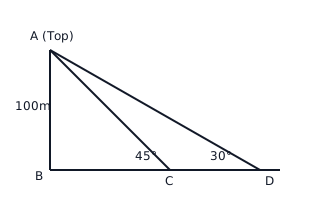
An observer on a cliff m high finds the angle of depression of a boat to be . After some time, the boat moves directly away from the cliff and the angle of depression becomes . Calculate the distance travelled by the boat during this period (use ).
Solution:
Let be the cliff of height m. Let be the initial position of the boat and be the final position. In : m. In : m. Distance travelled m. m.
Explanation:
We use the properties of right triangles. The first angle gives the initial distance, and the second angle gives the total distance from the cliff. Subtracting the two gives the distance the boat moved.
Problem 4:
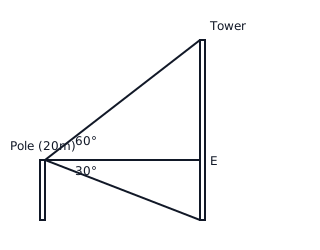
A vertical pole and a vertical tower are on the same level ground. From the top of the pole, m high, the angle of elevation of the top of the tower is and the angle of depression of the foot of the tower is . Find the height of the tower.
Solution:
Let m be the pole and be the tower. Let be the horizontal line from the top of the pole to the tower. In (where is the foot of the tower): m. Since m. In (where is the top of the tower): m. Total height of tower m.
Explanation:
First, calculate the horizontal distance using the angle of depression to the foot. Then, use that distance and the angle of elevation to find the height of the tower section above the pole's height.