
Pair of Linear Equations in Two Variables - Plot and solve pair of linear equations graphically and interpret intersection outcomes
Review the key concepts, formulae, and examples before starting your quiz.
🔑Concepts
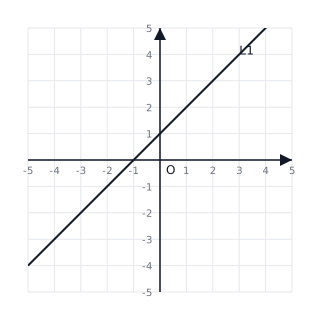
The general form of a pair of linear equations in two variables and is and . Geometrically, each equation represents a straight line on the Cartesian plane.
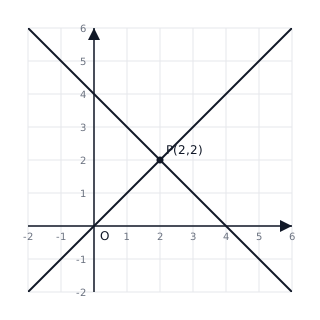
Intersecting Lines: If , the lines intersect at exactly one point. This point is the unique solution to the system. The system is called consistent.
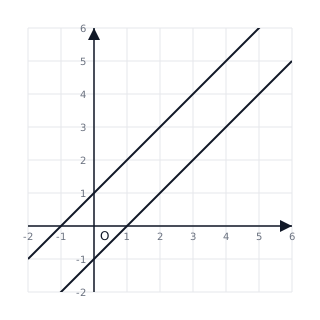
Parallel Lines: If , the lines never meet. There is no common solution, and the system is called inconsistent.
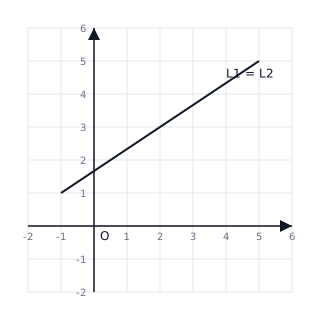
Coincident Lines: If , both equations represent the same line. There are infinitely many solutions. The system is called consistent and dependent.
📐Formulae
General Form:
Unique Solution (Intersecting):
No Solution (Parallel):
Infinitely Many Solutions (Coincident):
💡Examples
Problem 1:
Solve the pair of linear equations graphically: and .
Solution:
Step 1: Create a table for . If (Point ). If (Point ). Step 2: Create a table for . If (Point ). If (Point ). Step 3: Plot points and draw a line. Plot points and draw a second line. Step 4: Observe the intersection. The lines intersect at point . Therefore, .
Explanation:
We find two distinct points for each equation by substituting values for and solving for . By plotting these on a graph, the point where the lines cross represents the unique solution that satisfies both equations.
Problem 2:
Determine if the equations and are consistent and find the solution graphically.
Solution:
Step 1: Check coefficients: and . Step 2: Calculate ratios: and . Since , the system is consistent with a unique solution. Step 3: Plot : Points . Step 4: Plot : Points . Step 5: The lines intersect at . The solution is .
Explanation:
First, the algebraic ratio test confirms that the lines intersect. Graphing reveals the specific coordinate where the lines meet, providing the graphical solution.
Problem 3:
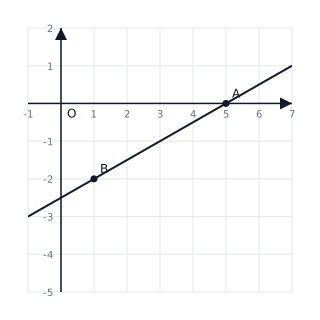
Show graphically that the system of equations and has infinitely many solutions.
Solution:
- For : Points are and .
- For : Dividing by 3, we get , which is the same equation.
- Since both equations represent the same line, every point on the line is a solution.
Explanation:
Here, , , and . Since all ratios are equal, the lines are coincident.
Problem 4:
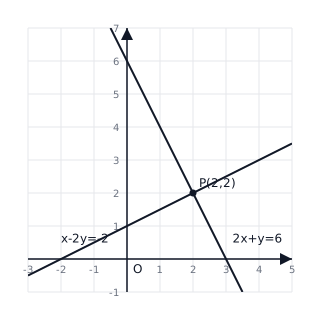
Solve the following pair of linear equations graphically and check the consistency:
Solution:
Step 1: Find at least two solutions for each equation to plot the lines. For :
- If , . Point:
- If , . Point:
For :
- If , . Point:
- If , . Point:
Step 2: Plot these points on a graph and draw the lines. Step 3: Observe the intersection point. The two lines intersect at the point .
Verification: Substitute into both equations: (True) (True)
Since the lines intersect at exactly one point, the system is consistent and has a unique solution .
Explanation:
The graphical method involves plotting the linear equations as straight lines on the Cartesian plane. The consistency of the system is determined by the intersection. Since and , then , confirming a unique solution.