
Pair of Linear Equations in Two Variables - Graphical Method of Solution of a Pair of Linear Equations
Review the key concepts, formulae, and examples before starting your quiz.
🔑Concepts
The general form of a pair of linear equations in two variables is and . Geometrically, each equation represents a straight line on a Cartesian plane.
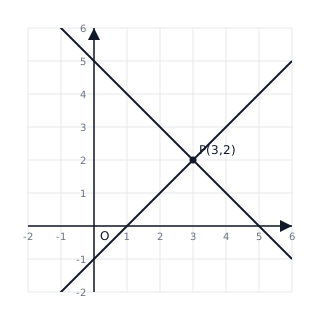
Intersecting Lines: If , the two lines intersect at exactly one point. This point is the unique solution to the system, and the pair of equations is called consistent.
Coincident Lines: If , the two lines lie on top of each other. Every point on the line is a solution, resulting in infinitely many solutions. This system is consistent and dependent.
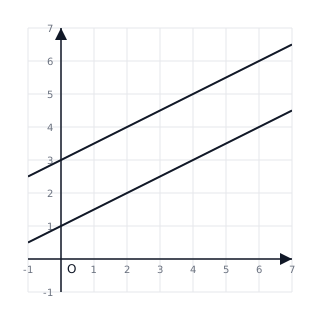
Parallel Lines: If , the lines never meet. There is no common point, meaning no solution exists. The pair of equations is called inconsistent.
📐Formulae
💡Examples
Problem 1:
Solve the following pair of linear equations graphically: and .
Solution:
- For : If ; if . Points are and .
- For : If ; if . Points are and .
- Plotting these points on a graph and drawing lines through them, we observe that the two lines intersect at the point .
- Therefore, and is the unique solution.
Explanation:
To solve graphically, we find at least two solutions (coordinates) for each equation, plot them on a Cartesian plane, and identify the point of intersection. Since , the lines must intersect at exactly one point.
Problem 2:
Check whether the pair of equations and is consistent and dependent.
Solution:
Compare ratios: Since , the lines are coincident.
Explanation:
When all three ratios of the coefficients are equal, the two equations represent the same line. This means they have infinitely many solutions, and the system is consistent and dependent.
Problem 3:
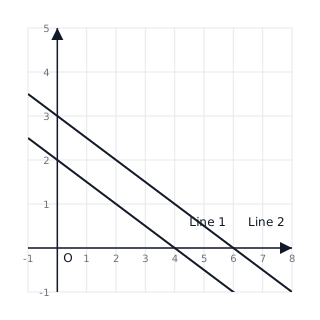
Determine graphically if the system of equations and is consistent or inconsistent.
Solution:
For : If ; if . Points:
For : If ; if . Points:
Comparing ratios: , , . Since , the lines are parallel. The system is inconsistent.
Explanation:
Parallel lines have no points in common, hence no solution. The constant slopes but different intercepts confirm they never meet.
Problem 4:
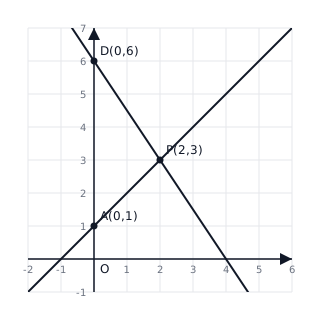
Solve the following pair of equations graphically and find the coordinates of the points where the lines intersect the y-axis:
Solution:
Step 1: Find points for . If (Point A: ). If (Point B: ). If (Point C: ).
Step 2: Find points for . If (Point D: ). If (Point E: ). If (Point F: ).
Step 3: Plot the points and draw the lines. The lines intersect at the point .
Step 4: Identify y-intercepts. For , the y-intercept is . For , the y-intercept is .
Explanation:
The graphical solution of a pair of linear equations is the point of intersection of the two lines. By plotting at least two points for each equation, we can draw the straight lines. The common point satisfies both equations. The y-intercepts are found by setting in each equation.