
Mensuration: Areas Related to Circles - Solve perimeter and area problems involving combinations of circular plane figures
Review the key concepts, formulae, and examples before starting your quiz.
🔑Concepts
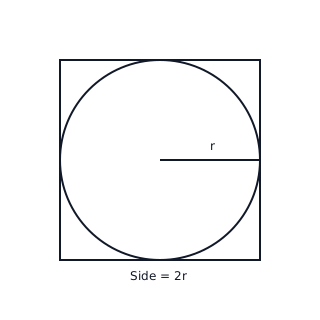
Combining regular polygons and circles: Area problems often involve subtraction or addition of plane figures. For instance, finding the area of a shaded region between a square and inscribed/circumscribed circles requires calculating the difference between their individual areas.
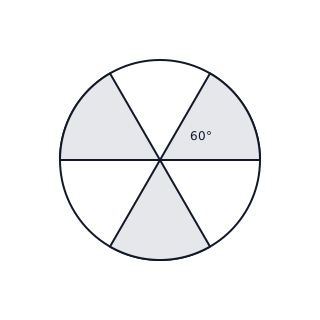
Design analysis in circular figures: Complex patterns like flowers or gears can be broken down into identical sectors or segments. The total area is the sum of these congruent parts, often calculated as , where is the number of symmetric regions.
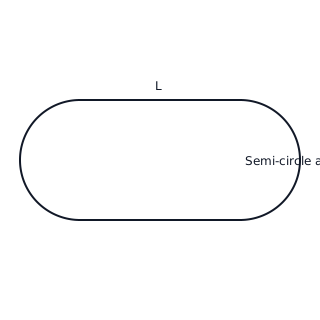
The Perimeter of combined figures: When calculating the perimeter of a shaded region, identify the boundaries. The perimeter is the sum of all external and internal boundary lengths, which may include straight edges (sides of polygons) and curved edges (circular arcs).
Quarter-circle subtractions: Problems frequently involve a square with quadrants removed from corners or semi-circles drawn on sides. The area of the remaining region is calculated by subtracting the sum of the areas of these circular components from the total area of the square.
📐Formulae
Area of a circle:
Circumference of a circle:
Area of a sector with central angle :
Length of an arc with central angle :
Area of a segment of a circle:
Area of an equilateral triangle:
Area of a square:
Relationship between radius () and side () of an inscribed equilateral triangle:
💡Examples
Problem 1:
A square has a side of cm. From each corner of the square, a quadrant of a circle of radius cm is cut and also a circle of diameter cm is cut from the center. Find the area of the remaining (shaded) portion of the square.
Solution:
Step 1: Calculate the area of the square . Step 2: Calculate the area of the four quadrants at the corners. Since : Step 3: Calculate the area of the central circle. The diameter is cm, so the radius cm. Step 4: Find the area of the remaining portion.
Explanation:
We use the subtraction method. The total area of the square is found first, then the areas of the parts 'removed' (the four quadrants and the central circle) are calculated and subtracted from the total.
Problem 2:
Find the area of the shaded region in a circle of radius cm where a central angle of forms a sector, and an equilateral triangle is formed by the radii and the chord joining their endpoints.
Solution:
Step 1: Area of the sector with and cm. Step 2: Since the central angle is and the two sides are radii (equal), the triangle is equilateral with side cm. Step 3: Area of the shaded segment. Taking and :
Explanation:
This problem requires calculating the area of a minor segment. We identify that a sector with equal radii must contain an equilateral triangle, then subtract the triangle's area from the sector's area.
Problem 3:
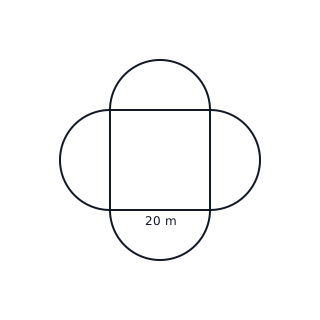
A square lawn of side m has four semi-circular flower beds at each side. Find the total area of the flower beds. (Use )
Solution:
- Side of the square m.
- Since the flower beds are semi-circles on the sides, the diameter of each semi-circle is equal to the side of the square.
- Diameter m, so radius m.
- Total area of 4 semi-circles = .
- Area =
- Area = .
Explanation:
The problem asks for the area of the components added to the square. Since there are four semi-circles with the same diameter, they effectively form two full circles.
Problem 4:
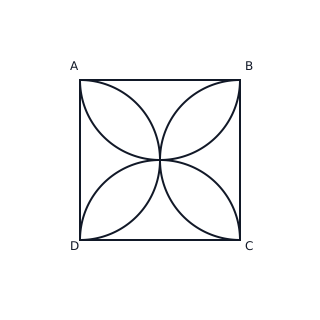
In the given figure, is a square of side cm. Semi-circles are drawn with each side of the square as diameter. Find the area of the shaded region (the four petals). (Use )
Solution:
- Area of Square .
- Let the unshaded regions be I, II, III, and IV.
- Area of (I + III) = Area of Square - Area of 2 semi-circles (on sides AD and BC)
- Area (I + III) = .
- Similarly, Area (II + IV) = .
- Area of shaded region = Area of Square - Area (I + II + III + IV)
- Area of shaded region = .
Explanation:
To find the area of the overlapping petals, we first find the area of the 'empty' spaces by subtracting semi-circles from the square. Then, we subtract those empty spaces from the total square area.