
Mensuration: Areas Related to Circles - Calculate area of sectors and segments of circles for standard central angles
Review the key concepts, formulae, and examples before starting your quiz.
🔑Concepts
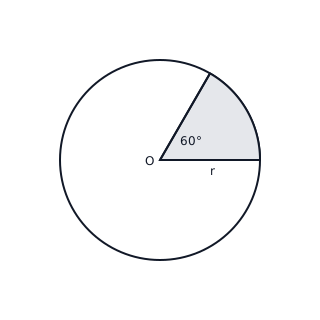
A sector is the region bounded by two radii and an arc of a circle. The area is proportional to the central angle . If , the area is . For any other angle , the area is .
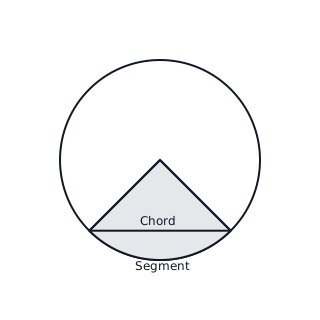
A segment is the region bounded by a chord and its corresponding arc. The area of a minor segment is found by subtracting the area of the triangle formed by the radii and the chord from the area of the corresponding sector.
Standard central angles frequently used in Grade 10 include , and . For these angles, the sector area is a specific fraction of the circle (e.g., is of the circle).
The area of the major sector or major segment is always calculated by subtracting the area of the minor part from the total area of the circle ().
📐Formulae
Area of a circle =
Circumference of a circle =
Length of an arc of a sector with angle =
Area of a sector of a circle with radius and angle =
Area of a major sector =
Area of a triangle with two sides as radii and included angle =
Area of a minor segment = Area of sector - Area of triangle =
Area of a major segment =
💡Examples
Problem 1:
Find the area of a sector of a circle with radius cm if the angle of the sector is . (Use )
Solution:
- Given: Radius cm, Angle .
- Use the formula: Area of sector = .
- Substitute the values: Area = .
- Simplify: Area = .
- Area = cm.
- In decimal form: Area cm.
Explanation:
To find the area of the sector, we determine the fraction of the total circle area using the ratio of the central angle to and multiply it by the full area .
Problem 2:
A chord of a circle of radius cm subtends a right angle at the center. Find the area of the corresponding minor segment. (Use )
Solution:
- Given: Radius cm, Central Angle .
- Step 1: Calculate Area of Sector = cm.
- Step 2: Calculate Area of Triangle cm (since the angle is ).
- Step 3: Area of Minor Segment = Area of Sector - Area of Triangle = cm.
Explanation:
The minor segment is the region between the chord and the arc. We find the area of the entire 'slice' (sector) and subtract the triangular part formed by the radii and the chord to leave only the segment area.
Problem 3:
In a circle of radius cm, an arc subtends an angle of at the centre. Find the area of the sector formed by the arc. (Use )
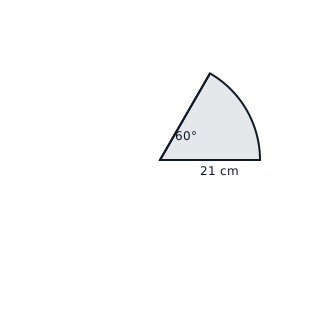
Solution:
Given: Radius () = cm Angle () =
Area of sector = Area = Area = Area = Area = Area = cm
Explanation:
To find the area of the sector, we identify the radius and the central angle. We substitute these into the formula for sector area and simplify the fraction to to make the calculation easier.
Problem 4:
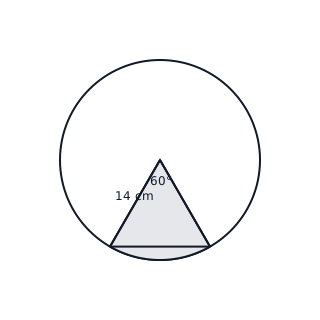
A chord of a circle of radius cm subtends an angle of at the centre. Find the area of the minor segment. (Use and )
Solution:
Given: cm,
-
Area of Sector = Area of Sector = cm
-
Area of Triangle = Since and , is equilateral. Area of Triangle = cm
-
Area of Minor Segment = Area of Sector - Area of Triangle Area = cm
Explanation:
Since the central angle is and the two bounding sides are radii, the triangle formed is equilateral. We find the area of the sector and subtract the area of this equilateral triangle to find the area of the segment.