
Review the key concepts, formulae, and examples before starting your quiz.
🔑Concepts
Ohm's Law states that the current () flowing through a conductor is directly proportional to the potential difference () across its ends, provided physical conditions like temperature remain constant. This is expressed as .
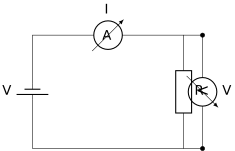
Resistance () is the measure of opposition to the flow of electric current. In a graph for an ohmic conductor, the slope of the line represents the resistance .
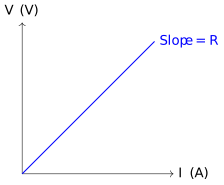
The SI unit of resistance is the Ohm (). One Ohm is defined as the resistance of a conductor such that a potential difference of causes a current of to flow through it.
Factors affecting resistance include the length of the conductor (), the cross-sectional area (), and the nature of the material (resistivity ). It is given by .
📐Formulae
💡Examples
Problem 1:
A circuit contains a resistor with a resistance of . If a battery is connected to the circuit, what is the current flowing through the resistor?
Solution:
Explanation:
Using Ohm's Law in the form , we substitute the known values for potential difference () and resistance () to find the current in Amperes.
Problem 2:
An electric heater draws a current of when connected to a supply. Calculate the resistance of the heating element.
Solution:
Explanation:
To find the resistance, we rearrange the formula to . Dividing the voltage by the current gives the resistance in Ohms.
Problem 3:
If the current passing through a resistor is , calculate the potential difference across it.
Solution:
Explanation:
First, convert units to standard SI units: and . Then apply to find the voltage.
Problem 4:
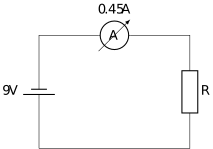
A simple circuit is constructed using a battery and a resistor. An ammeter connected in series measures a current of . Calculate the value of the unknown resistance .
Solution:
Given: Potential Difference Current
Using Ohm's Law:
Substitute the values:
Explanation:
To find the resistance, we rearrange the Ohm's Law formula to isolate . By dividing the voltage of the battery by the measured current, we find that the resistor opposes the current with a value of .
Problem 5:
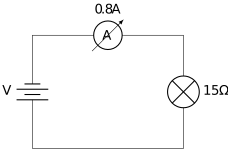
A circuit is designed with a lamp that has a resistance of . When the circuit is closed, the ammeter shows a reading of . Determine the potential difference supplied by the battery to the lamp.
Solution:
Explanation:
To find the potential difference (), we use the Ohm's Law formula by multiplying the current () flowing through the circuit by the resistance () of the lamp. Substituting the given values and yields a voltage of .