
Review the key concepts, formulae, and examples before starting your quiz.
🔑Concepts
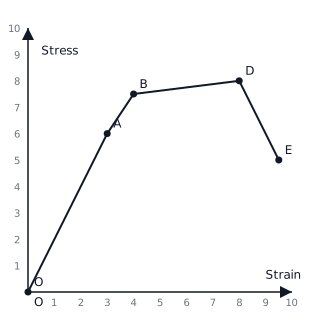
The Stress-Strain curve is divided into several regions. The first is the Proportional Limit (OA), where stress is directly proportional to strain, following Hooke's Law. Point B is the Elastic Limit or Yield Point, beyond which the material will not return to its original shape. Between B and D, the material exhibits plastic behavior. D is the Ultimate Tensile Strength point, and E is the Fracture point.
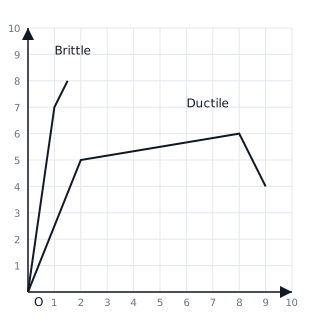
Ductile materials have a large plastic deformation region between the yield point and the fracture point (distance between B and E is large). Brittle materials, however, fracture almost immediately after the elastic limit (distance between B and E is very small).
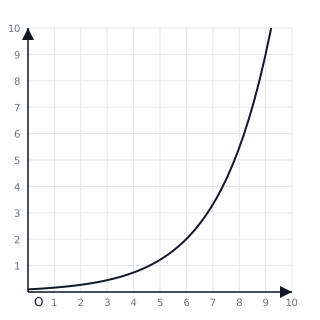
Elastomers are substances that can be stretched to cause large strains but do not obey Hooke's law. Even though they return to their original shape, the stress-strain curve is non-linear and does not have a well-defined plastic region, such as in the case of aortic tissue.
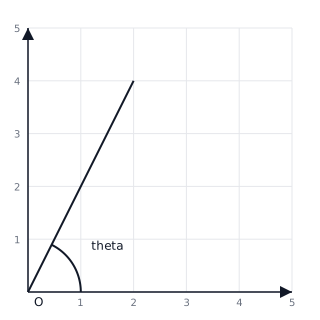
The slope of the linear portion (OA) of the stress-strain curve represents the Young's Modulus () of the material. A steeper slope indicates a higher Young's Modulus, meaning the material is more rigid and harder to deform.
📐Formulae
💡Examples
Problem 1:
A structural steel rod has a radius of and a length of . A force stretches it along its length. Given Young's modulus for steel is , calculate the stress and the elongation.
Solution:
First, calculate the cross-sectional area: Stress calculation: Elongation calculation:
Explanation:
Stress is found by dividing the applied force by the area of the rod. Then, using Hooke's Law within the proportional limit, the elongation is derived from the definition of Young's Modulus.
Problem 2:
During a tensile test, a specimen reaches a maximum load of before necking. If the original diameter was , find the Ultimate Tensile Strength.
Solution:
Radius . Area .
Explanation:
The Ultimate Tensile Strength corresponds to the stress value at the highest point (D) of the stress-strain curve.
Problem 3:
A wire of length and cross-sectional area is stretched by a load. If the stress-strain graph for the wire is a straight line passing through the origin and the point where stress is and strain is , calculate the Young's Modulus of the material and the force applied.
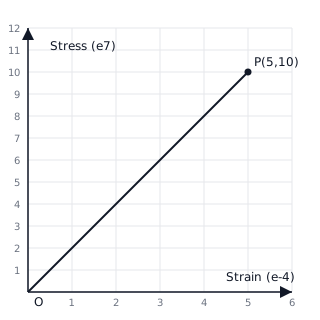
Solution:
- Young's Modulus is the slope of the stress-strain graph:
- Force can be found from stress: The Young's Modulus is and the force is .
Explanation:
In the elastic region, the ratio of stress to strain is constant and equal to Young's Modulus. Force is the product of stress and the cross-sectional area.
Problem 4:
Consider two wires and made of different materials. In a test, fails at a strain of and fails at a strain of . If both have the same elastic limit, which wire is more likely to be used for making springs and which for making sheets?
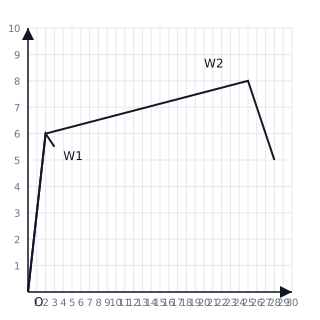
Solution:
has a very small plastic region (fails at strain) and is therefore brittle. has a large plastic region (fails at strain) and is ductile.
- (Brittle/High Elasticity): Better suited for applications where deformation must be recovered, like springs (assuming high yield strength).
- (Ductile): Better suited for making sheets (malleability) or wires (ductility) because it can undergo permanent deformation without breaking.
Explanation:
Ductility is the ability of a material to undergo significant plastic deformation before rupture. Materials with high failure strain are ductile, while those with low failure strain are brittle.