
Review the key concepts, formulae, and examples before starting your quiz.
🔑Concepts
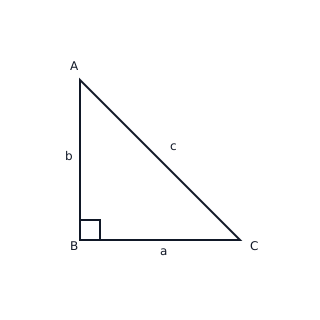
The Baudhayana-Pythagoras Theorem states that in a right-angled triangle, the square of the hypotenuse is equal to the sum of the squares of the other two sides: .
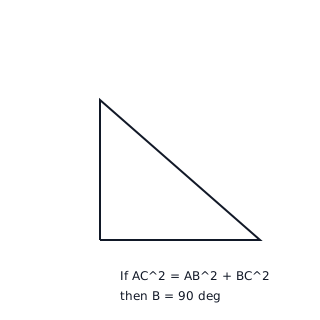
The Converse of the Baudhayana-Pythagoras Theorem states: If in a triangle, the square of one side is equal to the sum of the squares of the other two sides, then the angle opposite to the first side is a right angle.
A Pythagorean Triple is a set of three positive integers such that . Common examples include , , and .
To verify if a triangle with side lengths , , and (where is the longest side) is right-angled, we check if the equation holds true.
📐Formulae
💡Examples
Problem 1:
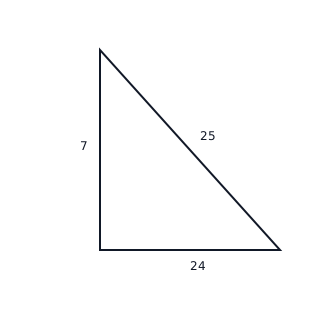
Check whether a triangle with sides , , and is a right-angled triangle.
Solution:
- Let the sides be , , and .
- Calculate the squares of the sides:
- Sum of the squares of the smaller sides:
- Since (), the condition of the Converse of the Baudhayana-Pythagoras theorem is satisfied. Therefore, the triangle is right-angled.
Explanation:
By squaring the side lengths, we find that the sum of the squares of the two shorter sides equals the square of the longest side. According to the converse theorem, this identifies the triangle as right-angled.
Problem 2:
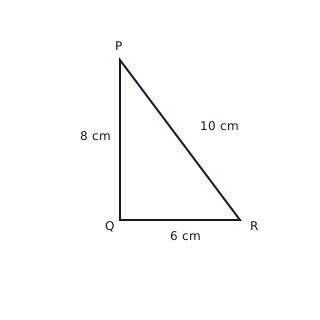
In , , , and . Find the measure of .
Solution:
- Given sides: , , .
- Identify the longest side: .
- Calculate squares:
- Check the relation: Since , the triangle is right-angled at the vertex opposite to the longest side .
- The vertex opposite to is . Thus, .
Explanation:
The side lengths satisfy the Baudhayana-Pythagorean relation . Since is the hypotenuse, the angle opposite to it, which is , must be .