krit.club logo

Math of Space: Surface Area and Volume - Guesstimate Problems

Grade 9CBSE

Review the key concepts, formulae, and examples before starting your quiz.

🔑Concepts

•

Guesstimation (Fermi Problems) involves using reasonable approximations and the standard formulae for Surface Area and Volume to solve real-world problems where exact measurements are not provided. For instance, estimating the number of drops in a lake or balls in a room.
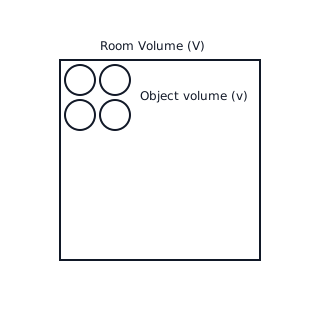
A large rectangle representing a room filled with small circles representing objects, illustrating the concept of N = V/v.
•

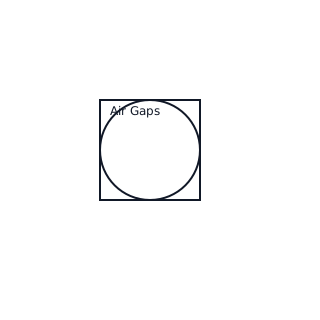
The Packing Fraction: In guesstimate problems, we assume that objects do not fill 100%100\% of a space due to gaps between them. For spherical objects in a rectangular container, we often assume they occupy roughly 60%60\% to 75%75\% of the total volume.

A circle inside a square showing the empty corners (void space).
•

Unit Conversion: Guesstimates often require converting units mentally. For example, 1 m3=1000 litres1 \text{ m}^3 = 1000 \text{ litres} and 1 cm3=1 ml1 \text{ cm}^3 = 1 \text{ ml}. Always ensure units are consistent (mm with mm, cmcm with cmcm) before performing division.

Flowchart showing unit conversion from cubic meters to litres to cubic centimeters.

📐Formulae

Number of units(N)≈Total VolumeVolume of one unit\text{Number of units} (N) \approx \frac{\text{Total Volume}}{\text{Volume of one unit}}

Volume of Sphere=43πr3\text{Volume of Sphere} = \frac{4}{3}\pi r^3

Volume of Cylinder=πr2h\text{Volume of Cylinder} = \pi r^2 h

Volume of Cuboid=l×b×h\text{Volume of Cuboid} = l \times b \times h

Surface Area of Sphere=4πr2\text{Surface Area of Sphere} = 4\pi r^2

💡Examples

Problem 1:

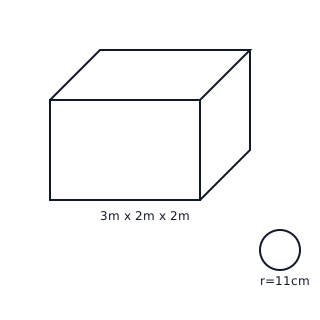
Guesstimate how many standard soccer balls (radius ≈11 cm\approx 11 \text{ cm}) can fit into a small storage room measuring 3 m×2 m×2 m3 \text{ m} \times 2 \text{ m} \times 2 \text{ m}. Assume a packing efficiency of 70%70\%.

A cuboid representing a storage room and a small circle representing a soccer ball.

Solution:

  1. Volume of room V=3×2×2=12 m3=12,000,000 cm3V = 3 \times 2 \times 2 = 12 \text{ m}^3 = 12,000,000 \text{ cm}^3.
  2. Volume of one ball v=43×π×113≈43×3.14×1331≈5572 cm3v = \frac{4}{3} \times \pi \times 11^3 \approx \frac{4}{3} \times 3.14 \times 1331 \approx 5572 \text{ cm}^3.
  3. Effective room volume = 0.70×12,000,000=8,400,000 cm30.70 \times 12,000,000 = 8,400,000 \text{ cm}^3.
  4. Number of balls N=8,400,0005,572≈1507N = \frac{8,400,000}{5,572} \approx 1507.

Rounding for a guesstimate, approximately 15001500 balls.

Explanation:

We calculate the total volume of the cuboidal room and the spherical ball. Because spheres don't stack perfectly, we apply a 70%70\% multiplier to the room's volume to account for air gaps.

Problem 2:

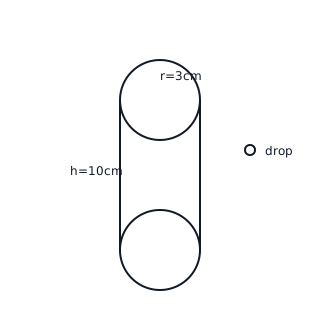
Estimate the number of drops of water in a cylindrical glass of height 10 cm10 \text{ cm} and radius 3 cm3 \text{ cm}. Assume one drop is a sphere with a diameter of 4 mm4 \text{ mm}.

A cylinder representing a glass and a tiny circle representing a drop of water.

Solution:

  1. Volume of cylindrical glass V=πr2h=π×32×10=90π≈282.6 cm3V = \pi r^2 h = \pi \times 3^2 \times 10 = 90\pi \approx 282.6 \text{ cm}^3.
  2. Radius of a drop =2 mm=0.2 cm= 2 \text{ mm} = 0.2 \text{ cm}.
  3. Volume of one drop v=43π(0.2)3=43π(0.008)≈0.0335 cm3v = \frac{4}{3} \pi (0.2)^3 = \frac{4}{3} \pi (0.008) \approx 0.0335 \text{ cm}^3.
  4. Number of drops N=282.60.0335≈8435N = \frac{282.6}{0.0335} \approx 8435.

In guesstimate terms, there are roughly 80008000 to 90009000 drops.

Explanation:

Convert all measurements to cm. Calculate the volume of the cylinder (the glass) and the volume of a sphere (the drop). Divide the total volume by the volume of a single drop.

Guesstimate Problems Class 9 Notes & Examples | CBSE Maths